
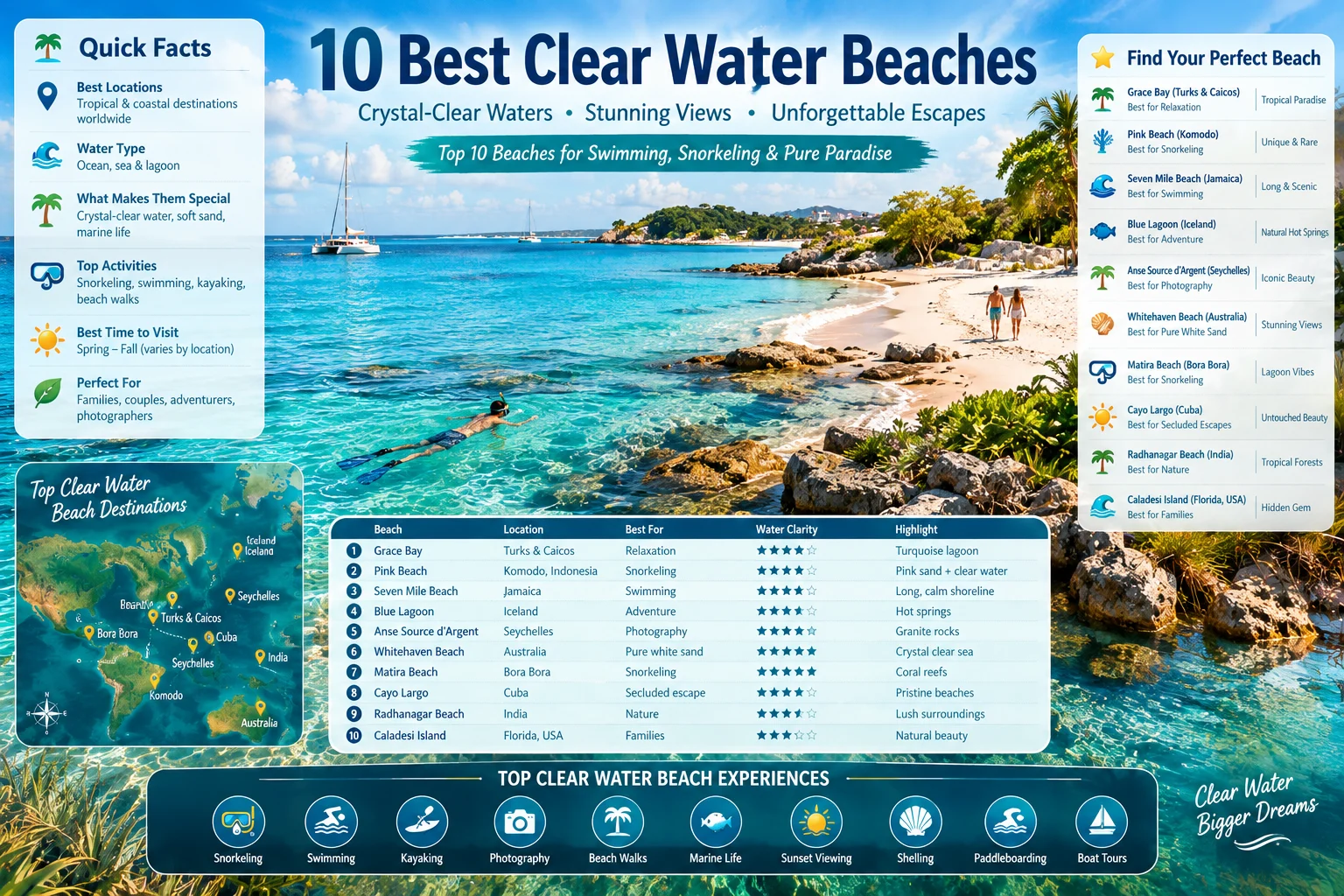

Clear water beaches stand out for their exceptional visibility, pale sand, protected lagoons, coral reefs, and striking blue-green water. From Grace Bay and Whitehaven Beach to Radhanagar and Caladesi Island, these destinations offer memorable swimming, snorkeling, photography, and relaxation.
There’s something instantly captivating about a beach where you can see straight through the water to the sand below.
That clarity can come from several factors, including pale sand, shallow lagoons, low sediment, reef protection, water movement, and local environmental conditions. So while “clear water” sounds simple, the experience can be very different from one destination to another.
Some beaches are perfect for floating in calm shallows. Others are better for snorkeling, kayaking, photography, or exploring marine life.
This guide highlights 10 clear water beaches worth putting on your travel list, with a practical look at what makes each one special and what type of traveler will enjoy it most.
Quick Facts
| Feature | Details |
|---|---|
| Focus | Clear water beaches |
| Destinations | Caribbean, Pacific, Indian Ocean, Mediterranean, and Gulf Coast |
| Best Activities | Swimming, snorkeling, kayaking, photography, boating |
| Common Water Colors | Turquoise, aqua, emerald, deep blue |
| Best Conditions | Often calm, sunny, and low-sediment conditions |
| Ideal Travelers | Families, couples, photographers, snorkelers, nature lovers |
| What Improves Visibility | Shallow water, pale sand, reefs, sheltered bays |
| Important Note | Water clarity changes with weather, tides, wind, and season |
What Makes a Beach Have Clear Water?
Clear water isn’t simply about how blue the ocean looks in a photograph.
Water visibility depends on several environmental factors. Fine sediment, algae, storms, waves, rainfall, and coastal runoff can reduce clarity. In contrast, sheltered bays, sandy bottoms, coral reefs, and calm conditions can help create the glass-like appearance travelers associate with crystal-clear beaches.
That’s why two beaches in the same region can look completely different on different days.
For travelers, this also means photographs shouldn’t be treated as a guarantee of daily conditions.
Grace Bay Beach, Turks and Caicos
Best for: Calm swimming, luxury escapes, water sports
Grace Bay is one of the clearest examples of the classic Caribbean beach experience.
Located on Providenciales, the beach combines brilliant white sand with striking turquoise water. A barrier reef offshore helps protect the bay from larger ocean swells, which contributes to the calm conditions often experienced along the beach. Grace Bay is also part of Princess Alexandra National Park.
The water isn’t the only attraction.
Visitors can go kayaking, paddleboarding, sailing, parasailing, and take boat trips around the surrounding waters. Snorkeling directly from the main beach is more limited, but nearby reef sites provide opportunities to explore underwater life.


Why visit?
Grace Bay works particularly well if your idea of a perfect beach involves soft white sand, shallow-looking turquoise water, comfortable swimming, and plenty of nearby activities.
Must-do experience: Take a boat or paddleboard excursion beyond the main shoreline and explore the surrounding reef environment.
Whitehaven Beach, Australia
Best for: Photography, white sand, unforgettable scenery
Whitehaven Beach on Whitsunday Island is one of Australia’s most recognizable coastal landscapes.
Its combination of dazzling white silica sand and turquoise water creates the kind of contrast that looks almost unreal. Tourism Whitsundays states that the beach stretches for more than seven kilometres and that its sand is about 98% silica.
Tourism Australia also highlights Whitehaven for its white sands and turquoise waters, while the Whitsundays are known for snorkeling, sailing, and access to the Great Barrier Reef region.
The nearby Hill Inlet is another major attraction. Changing tides move the sand and water together, creating swirling patterns of blue, green, and white.


Why visit?
This is the beach for travelers who want dramatic scenery rather than a conventional resort beach.
Must-do experience: See Hill Inlet from an elevated viewpoint before walking onto the famous silica sand.
Anse Source d’Argent, Seychelles
Best for: Photography, granite scenery, shallow clear water
Anse Source d’Argent on La Digue is almost instantly recognizable.
Huge weathered granite boulders frame soft white sand and shallow turquoise water, creating one of the most distinctive beach landscapes in the Seychelles.
The official Seychelles tourism website describes the beach as one of the island’s major sights, with giant granite boulders, lush palms, white sand, and exceptionally clear water.
Its sheltered lagoon can be especially attractive for swimming at higher tide. Official Seychelles information notes that parts of the lagoon become very shallow during low tide.


Why visit?
If your definition of a perfect beach includes unusual natural formations, this one is difficult to forget.
Must-do experience: Walk between the enormous granite formations and photograph the contrast between rock, sand, palms, and turquoise water.
Seven Mile Beach, Jamaica
Best for: Long beach walks, swimming, relaxed Caribbean atmosphere
Negril’s Seven Mile Beach offers a completely different interpretation of clear water beaches.
Instead of dramatic rocks or tiny coves, the attraction is the expansive shoreline, soft pale sand, and clear turquoise Caribbean water.
Jamaica’s official tourism website describes Negril as famous for white-sand beaches and crystal-clear turquoise water. It also highlights Seven Mile Beach for water sports.
The beach is particularly appealing for travelers who want plenty of room to walk, swim, relax, and enjoy the coastal atmosphere.


Why visit?
It combines clear water with a lively but relaxed beach culture.
Must-do experience: Spend part of the day in the water, then stay for sunset as the coastline changes color.
Matira Beach, Bora Bora
Best for: Lagoon swimming, snorkeling, romantic escapes
Matira is one of Bora Bora’s most famous public beaches.
Tahiti Tourisme describes it as a two-kilometre stretch of white sand and coconut palms beside a lagoon filled with blue and green tones. The official tourism site also highlights snorkeling and sunset viewing as key experiences.
The lagoon setting is what makes the experience special.
Instead of facing an uninterrupted open ocean, you’re surrounded by the distinctive landscape of Bora Bora and its lagoon.


Why visit?
Matira is ideal if you want clear water combined with tropical island scenery and an easygoing lagoon experience.
Must-do experience: Snorkel during the day and return toward sunset for the changing colors across the lagoon.
Pink Beach, Komodo Island, Indonesia
Best for: Snorkeling, photography, unusual scenery
Pink Beach proves that a clear-water beach doesn’t have to look like every other tropical postcard.
Located within Komodo National Park, the beach combines pink-tinted sand with turquoise water, green hills, and a vibrant marine environment.
Indonesia’s official tourism information explains that the pink color comes from a mixture of white sand and fragments associated with red coral and microscopic organisms called foraminifera. The surrounding waters are also noted for coral reefs and abundant marine life.
Because it is inside a protected national park, visitors should follow conservation rules and local guidance.


Why visit?
It gives you something many clear-water beaches cannot: unusual sand color combined with underwater biodiversity.
Must-do experience: Take the short viewpoint hike before snorkeling to see the contrast between pink sand, blue water, and green hills.
Radhanagar Beach, India
Best for: Swimming, sunsets, peaceful beach time
Radhanagar Beach is located on Swaraj Dweep, formerly known as Havelock Island, in the Andaman and Nicobar Islands.
The official Andaman tourism website describes it as a beach with powdery white sand and calm turquoise waters, making it popular for relaxation, swimming, and sunset viewing.
The surrounding Andaman region is also known for marine biodiversity and water-based experiences including snorkeling and diving.
For travelers who prefer a slower beach day, Radhanagar offers a more nature-focused experience than highly developed resort destinations.


Why visit?
The combination of pale sand, clear water, tropical greenery, and sunset scenery gives the beach a strong sense of escape.
Must-do experience: Arrive before sunset and find a comfortable spot along the shoreline as the sky changes color.
Caladesi Island, Florida
Best for: Families, nature, kayaking, quiet beaches
Caladesi Island State Park offers a different type of clear-water experience.
Located offshore from Dunedin, Florida, the island is accessible by boat and is known for undeveloped beaches, white quartz sand, shallow clear water, and natural surroundings. Visit Florida notes that the island is accessible by ferry from Honeymoon Island and offers swimming, kayaking, fishing, hiking, and birdwatching.
That natural setting is the main attraction.
You won’t get the same resort-heavy atmosphere found at some Caribbean beaches. Instead, the experience revolves around the beach, wildlife, mangroves, and coastal landscape.


Why visit?
It’s a strong choice if you want clear water without giving up nature.
Must-do experience: Combine a beach swim with a kayak trip through the island’s mangrove environment.
Cala Macarella, Menorca, Spain
Best for: Mediterranean scenery, kayaking, snorkeling
Cala Macarella is a small Mediterranean cove in Menorca surrounded by pine-covered cliffs.
The official Balearic Islands tourism website describes its water as crystal clear and shallow, with rocky areas where visitors can see fish. It also highlights paddleboarding and kayaking.
Unlike large Caribbean beaches, Macarella feels more intimate.
The cove is surrounded by natural landscape rather than a broad urban beachfront, giving it a more secluded Mediterranean character.
Access can also be controlled during busy summer periods when parking reaches capacity, so planning ahead matters.


Why visit?
This is the pick for travelers who want clear water with Mediterranean cliffs and pine forests.
Must-do experience: Explore the cove by kayak or paddleboard and look into the rocky shallows for marine life.
Graceful Caribbean Alternative: Caladesi and the Gulf Coast Experience
If you’re specifically searching for clear water but want to stay within the United States, Caladesi Island deserves special attention.
Its sparkling emerald water, white quartz sand, shallow swimming areas, and undeveloped character make it different from the typical crowded resort beach. Visit Florida describes the water as clear and emerald-hued and notes that conditions can become rougher depending on wind, tides, and offshore systems.
For that reason, it’s also a useful reminder that “clear water” doesn’t automatically mean “perfect swimming conditions.”


Why visit?
The combination of clear Gulf water and protected natural surroundings makes Caladesi particularly appealing to travelers who prefer nature over large resort zones.
Must-do experience: Take the ferry, walk the boardwalk, then explore the beach and surrounding nature trails.
Best Clear Water Beaches at a Glance
| Beach | Country/Region | Best For | Standout Feature |
|---|---|---|---|
| Grace Bay | Turks and Caicos | Swimming | Turquoise water and white sand |
| Whitehaven Beach | Australia | Photography | Silica sand and turquoise sea |
| Anse Source d’Argent | Seychelles | Photography | Granite boulders and shallow lagoon |
| Seven Mile Beach | Jamaica | Relaxation | Long white-sand coastline |
| Matira Beach | Bora Bora | Snorkeling | Blue-green lagoon |
| Pink Beach | Indonesia | Adventure | Pink sand and coral-rich waters |
| Radhanagar Beach | India | Relaxation | White sand and turquoise water |
| Caladesi Island | Florida, USA | Nature | Clear emerald Gulf water |
| Cala Macarella | Menorca, Spain | Kayaking | Sheltered Mediterranean cove |
| Whitehaven Alternative | Australia | Island Escape | Whitsunday coastal scenery |
Clear Water Beaches for Different Travelers
Best for Families
Look for beaches with shallow water, protected bays, accessible facilities, and favorable swimming conditions.
Grace Bay and Caladesi Island can suit travelers who want a combination of clear water and calmer beach experiences, although conditions should always be checked locally.
Best for Snorkeling
Matira Beach, Pink Beach, and destinations around the Andaman Islands offer stronger underwater appeal.
Clear water is especially valuable for snorkeling because visibility determines how much of the reef and marine life you can actually see.
Best for Photography
Anse Source d’Argent, Whitehaven Beach, Pink Beach, and Cala Macarella offer very different visual styles.
Instead of simply looking for blue water, consider the entire composition: rock formations, sand color, cliffs, vegetation, and light.
Best for Relaxation
Seven Mile Beach and Radhanagar are excellent options for travelers who want to slow down.
Long stretches of sand can create a more spacious feeling, while sheltered beaches can provide a calmer atmosphere.
When Is the Best Time to Visit Clear Water Beaches?
There isn’t one universal “best month” for every beach.
Weather patterns, monsoon seasons, hurricane risks, tides, wind, rainfall, and local tourism seasons vary considerably between destinations.
For example, official Sri Lanka tourism information notes that different monsoon patterns affect different parts of its coastline at different times of year.
The same principle applies globally.
Before booking, check the destination’s official tourism information and local marine or weather guidance rather than assuming that summer automatically means the clearest water.
How to Make Clear Water Look Even Better in Photos
Clear water beaches are naturally photogenic, but timing makes a major difference.
Early morning can offer softer light and fewer people.
Late afternoon often produces warmer tones and longer shadows.
For underwater photography, visibility, sun position, water movement, and local conditions matter more than simply choosing the brightest day.
And don’t forget to photograph more than the water.
Capture the sand, rocks, vegetation, boats, marine life, and surrounding landscape to tell the complete story of the destination.
Clear Water Doesn’t Always Mean Safe Water
This is one of the most important things to remember.
Water can look calm and transparent while currents, tides, waves, boats, or changing weather create hazards.
Before swimming or snorkeling, check local warnings and follow lifeguard or ranger instructions.
In protected areas such as Komodo National Park, conservation and visitor rules also matter. Indonesia’s tourism authorities specifically encourage visitors to respect the protected environment and avoid damaging coral or removing natural materials.
Final Thoughts
The world’s clear water beaches are not all beautiful for the same reason.
Grace Bay delivers classic Caribbean turquoise. Whitehaven creates an almost surreal contrast between silica sand and blue water. Anse Source d’Argent adds enormous granite formations. Pink Beach introduces an unusual coral-influenced shoreline, while Cala Macarella offers a secluded Mediterranean setting.
That variety is what makes clear water beaches so fascinating.
So instead of searching only for the bluest water, think about the experience you actually want.
Want easy swimming? Look for calm, shallow water.
Want underwater adventures? Choose a reef-rich destination.
Want unforgettable photographs? Look for distinctive landscapes as well as clear water.
Want peace and nature? Choose a less-developed beach.
The clearest water may get your attention first, but the surrounding landscape, wildlife, activities, and atmosphere are what can turn a beautiful beach into a trip you remember.
