
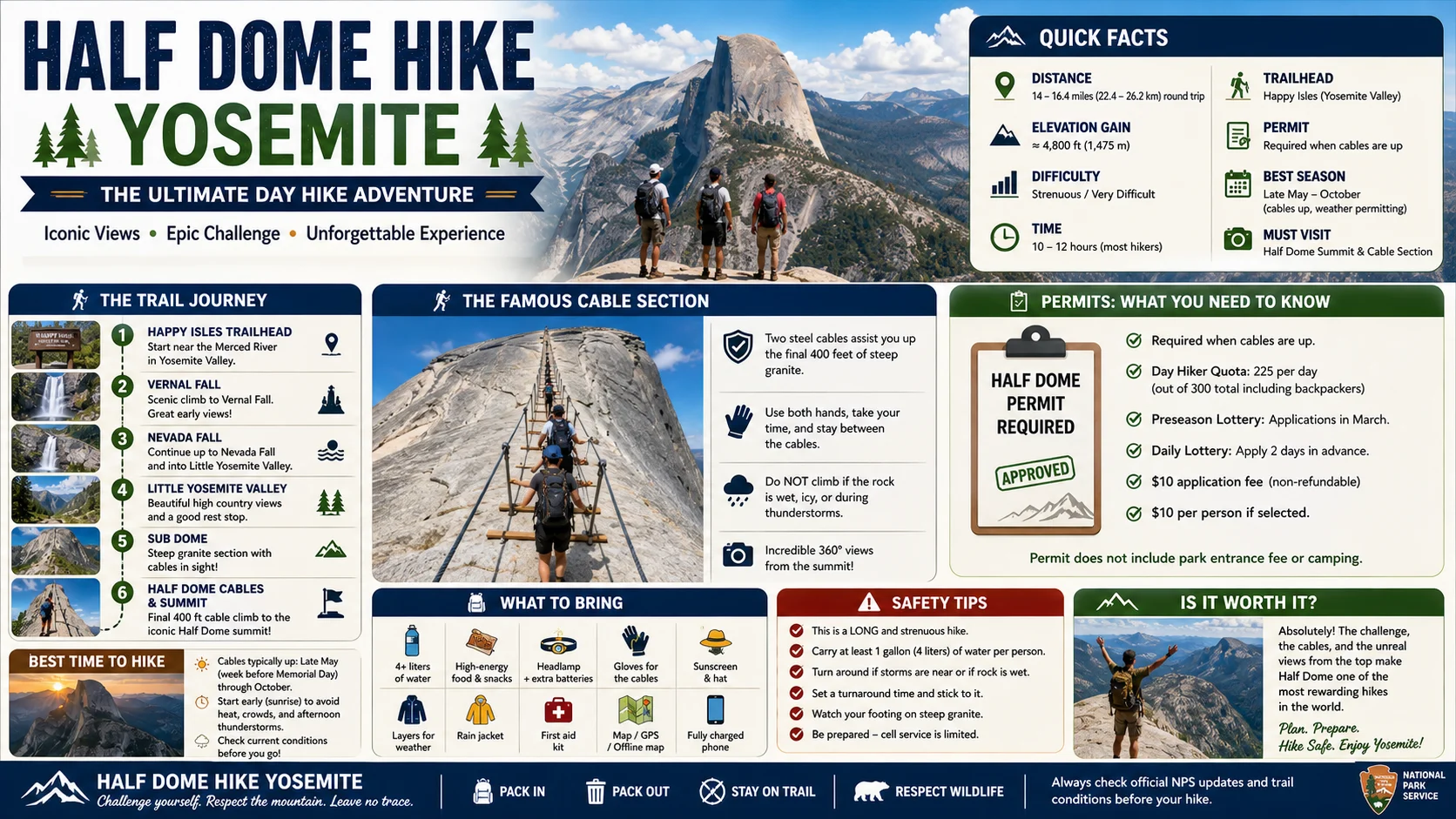

The Half Dome hike in Yosemite is a strenuous 14–16.4-mile (22.4–26.2 km) round-trip trail with about 4,800 feet (1,460 m) of elevation gain. Most hikers take 10–12 hours. A permit is required when the Half Dome cables are open, and the final 400-foot cable section is steep and exposed.


If you’re searching for an unforgettable adventure in Yosemite National Park, the Half Dome hike Yosemite is one of the park’s most challenging and iconic day hikes.
Starting near Happy Isles in Yosemite Valley, the trail climbs past Vernal Fall and Nevada Fall before reaching Little Yosemite Valley, Sub Dome, and finally the famous steel cables leading to the summit.
The hike is long, steep, exposed, and physically demanding but the panoramic views from the top make it a bucket-list experience for prepared hikers.
Quick Facts
| Feature | Half Dome Hike |
|---|---|
| Distance | 14–16.4 miles (22.4–26.2 km) round trip |
| Elevation Gain | About 4,800 ft (1,475 m) |
| Difficulty | Strenuous / Very Difficult |
| Time | Usually 10–12 hours |
| Best For | Experienced, well-prepared hikers |
| Trailhead | Happy Isles |
| Permit | Required when cables are up |
| Must Visit | Half Dome Summit & Cable Route |
NPS lists the hike at roughly 14–16 miles round trip with about 4,800 feet of elevation gain; its Yosemite Valley trail information gives the route via the John Muir Trail as 16.2 miles round trip and 4,830 feet of gain.
What Makes the Half Dome Hike So Special?


Half Dome isn’t simply a long mountain trail. The hike combines waterfalls, forest, granite cliffs, high-elevation scenery, and one of the most recognizable cable-assisted summit climbs in the United States.
The final approach is especially memorable: hikers ascend approximately 400 feet of steep granite using two steel cables. The cables are what turn an already strenuous hike into a serious summit challenge.
From the summit, you can look across Yosemite Valley and toward the High Sierra.
Half Dome rises nearly 5,000 feet above Yosemite Valley and reaches roughly 8,800 feet above sea level.
Half Dome Hike Route: Happy Isles to the Summit


The standard hike begins at Happy Isles in Yosemite Valley.
A typical route follows:
Happy Isles → Vernal Fall → Nevada Fall → Little Yosemite Valley → Sub Dome → Half Dome Cables → Summit
The John Muir Trail section takes hikers past Vernal and Nevada Falls before continuing toward Little Yosemite Valley. From there, the route becomes increasingly steep as you approach Sub Dome and the cable section.
1. Happy Isles to Vernal Fall
The early section takes you into the Merced River canyon and toward Vernal Fall.
This part can already feel demanding because you’re gaining elevation from the valley floor. Starting early is particularly useful because it gives you more daylight for the long return journey.
2. Nevada Fall & Little Yosemite Valley
Beyond Vernal Fall, the route continues toward Nevada Fall and then Little Yosemite Valley.
This is an important point on the hike because you’ve still got the steepest and most exposed sections ahead.
3. Sub Dome
The approach to Sub Dome introduces steep granite steps and a major increase in difficulty.
This is where pacing becomes important. Don’t burn too much energy early in the hike you still need enough strength for the cables and the long descent.
Half Dome Cables: The Most Famous Section


The Half Dome cables are the defining feature of the hike.
Two steel cables run up the final steep granite section, with wooden planks providing occasional footholds.
The climb is not a technical rock-climbing route, but it is highly exposed and requires strength, balance, confidence, and careful footing.
Important: You should not attempt the cables when the rock is wet, icy, or during threatening storm conditions. NPS specifically warns hikers against using the cables when they are down and advises avoiding the ascent when storms are nearby.
Gloves with good grip can make handling the cables more comfortable. Good traction footwear is also important.
Half Dome Permit: Do You Need One?


Yes. A permit is required to hike to the top of Half Dome when the cables are up.
For day hikers, permits are distributed through a lottery system:
- Preseason lottery: Applications are normally accepted in March.
- Daily lottery: Limited permits may become available two days before the hiking date.
- Daily quota: About 225 day-hiker permits are available.
- Application fee: $10 per application.
- Permit fee: $10 per person if your application is successful.
The overall Half Dome quota beyond the Sub Dome is approximately 300 people per day, including about 225 day hikers and 75 backpackers.
If you’re backpacking, the Half Dome permit is handled together with an eligible wilderness permit rather than through the normal day-hiker process.
2026 note: Yosemite does not require an entrance reservation in 2026, but that does not replace the Half Dome permit requirement.
Best Time to Hike Half Dome


The main cable season is generally from late May through October, but the exact opening and closing dates can change according to conditions.
NPS normally puts the cables up on the Friday before the last Monday in May and takes them down after the second Monday in October, subject to weather and trail conditions.
For most hikers, a warm-weather period with dry trail conditions is preferable.
However, summer can also mean heat, crowds, and intense sun exposure. Autumn can bring cooler conditions, but weather becomes increasingly important.
Always check Yosemite’s current conditions before your hike.
How Long Does the Half Dome Hike Take?
Most hikers take approximately 10–12 hours for the complete round trip, although slower hikers may need longer.
A sunrise or earlier start is recommended by NPS because of the hike’s length.
Don’t focus only on reaching the summit. You also need enough daylight and energy for the descent.
A practical strategy is to establish a firm turnaround time before starting.
What to Pack for Half Dome
For such a long hike, preparation matters as much as fitness.
Essential Gear
- Comfortable hiking shoes or boots with good traction
- At least 4 liters of water per person
- Electrolytes
- High-energy snacks and lunch
- Headlamp with spare batteries
- Gloves with good grip for the cables
- Sun protection
- First-aid supplies
- Navigation/map backup
- Weather-appropriate layers
- Fully charged phone
- Emergency supplies
NPS recommends carrying approximately 1 gallon (4 liters) of water per person for the summit hike and carrying a proper flashlight or headlamp with extra batteries.
Half Dome Hike Difficulty


Difficulty: Very strenuous
The difficulty comes from the combination of:
- 14–16+ miles of hiking
- Around 4,800 feet of elevation gain
- Long periods of climbing
- Steep granite
- Exposure
- The cable ascent
- High temperatures during summer
- A demanding descent after already hiking for several hours
This isn’t a trail I’d recommend treating like an ordinary sightseeing walk.
You should be comfortable with long, steep hikes before attempting Half Dome.
Half Dome Hike Comparison
| Feature | Half Dome Day Hike | Half Dome Backpacking |
|---|---|---|
| Distance | ~14–16.4 mi RT | Route-dependent |
| Elevation Gain | ~4,800 ft | Route-dependent |
| Time | Usually 10–12 hrs | 2+ days depending on itinerary |
| Permit | Half Dome permit | Wilderness + Half Dome permit |
| Main Challenge | Long day + cables | Extended mountain trip |
| Best For | Strong day hikers | Experienced backpackers |
For overnight trips, wilderness permits are required, and eligible backpacking routes can include Half Dome permits.
Half Dome Safety Tips
The biggest mistake is treating the cables like a photo opportunity rather than a serious mountain section.
Keep these rules in mind:
- Never climb the cables during a storm.
- Avoid the cables when the granite is wet or slippery.
- Don’t rush other hikers on the cables.
- Keep three points of contact whenever possible.
- Carry enough water for the entire trip.
- Start early.
- Bring a real headlamp.
- Set a turnaround time.
- Watch the weather throughout the day.
- Be prepared to turn around.
Weather can change quickly in the mountains, and the exposed summit is particularly dangerous during lightning storms. NPS also notes that Half Dome’s summit can be significantly colder than Yosemite Valley.
Is the Half Dome Hike Worth It?


For hikers who are physically prepared, have the required permit, and are comfortable with the exposure of the cable section, Half Dome offers a remarkable combination of scenery and challenge.
But you don’t need to reach the summit simply because you started the hike.
If conditions become unsafe, turning around is the right trail decision. The mountain will still be there another day.
FAQs
How long is the Half Dome hike?
The hike is approximately 14–16.4 miles (22.4–26.2 km) round trip, depending on the route used.
How much elevation gain does Half Dome have?
Expect approximately 4,800 feet (1,475 m) of elevation gain.
How many hours does Half Dome take?
Most hikers take around 10–12 hours, although individual times vary.
Do you need a permit for Half Dome?
Yes. A Half Dome permit is required to reach the summit when the cables are up.
Are the Half Dome cables difficult?
The cables are steep and exposed. They require careful footing, upper-body effort, and confidence on granite. Weather conditions can make the section significantly more hazardous.
Can beginners hike Half Dome?
The trail is generally not appropriate for an inexperienced hiker. Its length, elevation gain, steep terrain, and cable section require substantial preparation.
When are the Half Dome cables open?
They are normally installed from late May through October, but opening and closing dates depend on conditions.
Final Thoughts
The Half Dome hike Yosemite is more than a famous trail it is a full-day mountain challenge combining waterfalls, granite landscapes, elevation, exposure, and the unforgettable cable climb.
With approximately 14–16.4 miles of hiking and around 4,800 feet of elevation gain, preparation is essential. Get the right permit, check conditions, start early, carry enough water, and treat the cables with the respect they deserve.
For prepared hikers, the summit provides one of Yosemite’s most memorable high-elevation experiences.
