
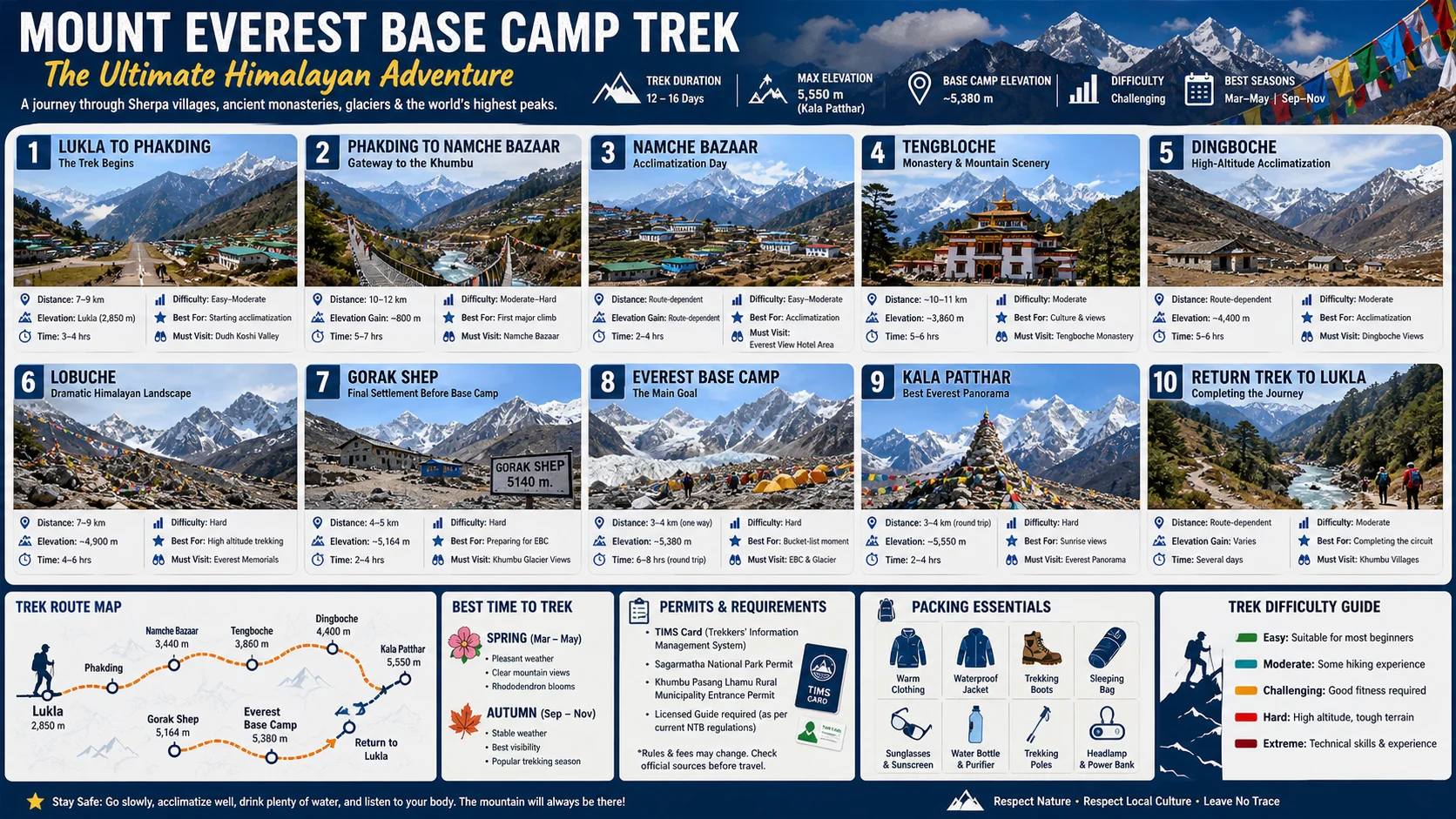

The Mount Everest Base Camp Trek is one of the world’s most iconic high-altitude adventures. You don’t need to climb Mount Everest to experience the Himalayas you can trek through Sherpa villages, Buddhist monasteries, suspension bridges, glaciers, and dramatic mountain valleys all the way to Everest Base Camp.
The classic route begins at Lukla and travels through Namche Bazaar, Tengboche, Dingboche, Lobuche, and Gorak Shep before reaching Everest Base Camp. Nepal Tourism Board describes the standard trek as roughly a two-week journey starting and finishing at Lukla, although actual itineraries vary depending on acclimatization days, weather, and transportation.
Important: Distances and hiking times below are approximate because itineraries and trail sections vary. High-altitude weather can also change conditions quickly.
Mount Everest Base Camp Trek at a Glance
| Feature | Details |
|---|---|
| Location | Khumbu, Nepal |
| Starting Point | Lukla |
| Base Camp Elevation | ~5,380 m / 17,650 ft |
| Mount Everest Elevation | 8,848 m |
| Typical Trek Duration | ~12–16 days |
| Difficulty | Challenging |
| Highest Common Point | Kala Patthar, depending on itinerary |
| Best For | Experienced trekkers & adventure travelers |
| Best Seasons | Spring and autumn |
1. Lukla to Phakding — The Trek Begins
The adventure normally starts with arrival in Lukla, the gateway to the Everest region. From here, trekkers descend and follow the Dudh Koshi valley toward Phakding.
This first section is comparatively gentle, allowing trekkers to get used to walking in the Himalayas before the route becomes significantly steeper.
Quick Facts
- Distance: Approximately 7–9 km, depending on the exact route
- Elevation: Lukla is around 2,850 m
- Difficulty: Easy–Moderate
- Time: Approximately 3–4 hours
- Best For: Starting the acclimatization process
- Must Visit: Lukla viewpoint and Dudh Koshi valley
⭐ Must Visit: Dudh Koshi Valley
The river valley provides the first taste of the dramatic Himalayan environment, with suspension bridges, pine forests, and mountain villages.


2. Phakding to Namche Bazaar — Gateway to the Khumbu
The trail follows the Dudh Koshi River toward Namche Bazaar, the major trading and acclimatization center of the Everest region.
The route becomes steeper after entering Sagarmatha National Park, with several suspension bridges and a substantial final climb into Namche.
Quick Facts
- Distance: Approximately 10–12 km
- Elevation Gain: Approximately 800 m
- Difficulty: Moderate–Hard
- Time: Approximately 5–7 hours
- Best For: First major Himalayan trekking day
- Must Visit: Namche Bazaar
⭐ Must Visit: Namche Bazaar
Namche is one of the most important settlements on the route and is traditionally used as an acclimatization stop. Nepal Tourism Board identifies Namche as a key staging point on the Everest route.


3. Namche Bazaar Acclimatization Day — Best for Mountain Views
Acclimatization is one of the most important parts of the Mount Everest Base Camp Trek. Rather than simply resting all day, many itineraries include a short hike around Namche before returning to the village.
Quick Facts
- Distance: Route-dependent
- Elevation Gain: Route-dependent
- Difficulty: Easy–Moderate
- Time: 2–4 hours
- Best For: Acclimatization and panoramic views
- Must Visit: Everest View Hotel area
⭐ Must Visit: Everest View Area
The surrounding hills provide early views toward Everest and neighboring Himalayan peaks. Keep the hike relatively easy the purpose of this day is acclimatization, not maximum distance.


4. Tengboche — Best Monastery & Mountain Scenery
From Namche, the trail climbs and descends through the Khumbu landscape before reaching Tengboche, home to one of the region’s most famous Buddhist monasteries.
The scenery becomes increasingly dramatic, with views toward Everest, Lhotse, Ama Dablam, and surrounding peaks.
Quick Facts
- Distance: Approximately 10–11 km from Namche
- Elevation: Approximately 3,860 m
- Difficulty: Moderate
- Time: Approximately 5–6 hours
- Best For: Culture and Himalayan scenery
- Must Visit: Tengboche Monastery
⭐ Must Visit: Tengboche Monastery
The monastery is a major cultural landmark in the Khumbu. Nepal Tourism Board describes Tengboche as the leading Buddhist center of the region, surrounded by views of Everest, Lhotse, and Ama Dablam.


5. Dingboche — Best High-Altitude Acclimatization Stop
Dingboche sits high above the tree line and is commonly used as another acclimatization point. The landscape changes noticeably here: forests give way to alpine terrain, stone walls, and expansive mountain views.
Quick Facts
- Distance: Route-dependent
- Elevation: Approximately 4,400 m
- Difficulty: Moderate
- Time: Approximately 5–6 hours from Tengboche
- Best For: Acclimatization and high-altitude scenery
- Must Visit: Dingboche valley viewpoints
⭐ Must Visit: Dingboche Viewpoints
Short hikes above the village can provide spectacular views of the surrounding peaks. Keep the pace controlled because altitude not distance is the major challenge at this stage.


6. Lobuche — Best Dramatic Himalayan Landscape
The trail from Dingboche toward Lobuche enters an increasingly rugged environment. Trekkers pass memorials dedicated to climbers and continue along the Khumbu Glacier landscape.
Quick Facts
- Distance: Approximately 7–9 km from Dingboche
- Elevation: Approximately 4,900 m
- Difficulty: Hard
- Time: Approximately 4–6 hours
- Best For: High-altitude trekking
- Must Visit: Everest memorial area
⭐ Must Visit: Everest Memorials
The memorials near the trail serve as a sobering reminder of the risks associated with climbing in the high Himalayas.


7. Gorak Shep — The Final Settlement Before Base Camp
Gorak Shep is one of the highest settlements on the standard Everest Base Camp route. It is typically used as the final overnight stop before or after visiting Base Camp.
At this altitude, even relatively short distances can feel physically demanding.
Quick Facts
- Distance: Approximately 4–5 km from Lobuche
- Elevation: Approximately 5,164 m
- Difficulty: Hard
- Time: Approximately 2–4 hours
- Best For: Preparing for Everest Base Camp
- Must Visit: Gorak Shep viewpoint
⭐ Must Visit: Khumbu Glacier Landscape
The surrounding landscape becomes increasingly barren and dramatic, with glaciers, moraine, and enormous Himalayan peaks dominating the horizon.


8. Everest Base Camp — The Main Goal
Reaching Everest Base Camp is the highlight of the trek. The trail from Gorak Shep follows the Khumbu Glacier and moraine toward the famous base camp area.
Nepal Tourism Board lists Everest Base Camp at roughly 5,380 m, while some sources and route measurements may give slightly different figures depending on the exact point measured.
Quick Facts
- Distance: Approximately 3–4 km one way from Gorak Shep
- Elevation: Approximately 5,380 m
- Difficulty: Hard
- Time: Approximately 6–8 hours roundtrip from Gorak Shep
- Best For: Bucket-list Himalayan trekking
- Must Visit: Everest Base Camp
⭐ Must Visit: Everest Base Camp
Standing beneath the world’s highest mountain is the defining moment of the trek. Remember that Base Camp itself does not provide the classic unobstructed summit view of Everest that many visitors imagine.


9. Kala Patthar — Best Everest Panorama
For the classic panoramic view of Everest, many itineraries add an early-morning climb to Kala Patthar.
The route is steep and challenging at extreme altitude, but the viewpoint is famous for its broad views toward Everest, Nuptse, Pumori, and the surrounding Himalayan landscape.
Quick Facts
- Distance: Approximately 3–4 km roundtrip from Gorak Shep
- Elevation: Approximately 5,550 m at the high point, depending on the exact route
- Difficulty: Hard
- Time: Approximately 2–4 hours
- Best For: Sunrise photography and mountain panoramas
- Must Visit: Kala Patthar summit viewpoint
⭐ Must Visit: Sunrise View
An early start can provide spectacular Himalayan light across Everest and the surrounding peaks. Conditions can be extremely cold, so proper layers and careful pacing are essential.


10. Return Trek to Lukla — Completing the Journey
The return journey follows the Everest trail back through the Khumbu. Many trekkers appreciate this section because the lower altitude brings back greener landscapes and easier breathing.
Some itineraries shorten the return by using available flights or alternative transportation arrangements, but these depend on weather and current operations.
Quick Facts
- Distance: Route-dependent
- Elevation Gain: Route-dependent
- Difficulty: Moderate
- Time: Several trekking days
- Best For: Completing the classic circuit
- Must Visit: Namche Bazaar and lower Khumbu villages
⭐ Must Visit: Khumbu Villages
The return journey provides another opportunity to experience Sherpa villages, mountain culture, monasteries, and changing landscapes that are easy to miss when focusing only on reaching Base Camp.


Mount Everest Base Camp Trek Route
A common classic itinerary follows:
Lukla → Phakding → Namche Bazaar → Tengboche → Dingboche → Lobuche → Gorak Shep → Everest Base Camp → Kala Patthar → return to Lukla
Exact itineraries vary. Nepal Tourism Board describes the classic trek as starting and finishing in Lukla and generally taking around two weeks, while longer itineraries can provide additional acclimatization time.
Everest Base Camp Trek Difficulty
The Everest Base Camp Trek is generally considered challenging, primarily because of altitude rather than technical climbing.
The route reaches more than 5,000 meters, and trekkers must deal with long walking days, steep sections, cold temperatures, thin air, and unpredictable mountain weather.
You do not need mountaineering skills for the standard trek, but good cardiovascular fitness, preparation, appropriate equipment, and sensible acclimatization are important.
Best Time for Everest Base Camp Trek
The most popular trekking periods are generally spring and autumn.
Spring: March–May
Autumn: late September–November
These periods are commonly favored for trekking conditions and mountain visibility, although weather can vary from year to year. Nepal Tourism Board also identifies spring and autumn as prime periods for the Everest region.
Winter is much colder at high elevations, while the monsoon season can bring rain, cloud, and travel disruptions.
Everest Base Camp Trek Permits & Requirements
This is an area where travelers should use current official information rather than relying on old blog posts.
Nepal Tourism Board currently lists Everest Base Camp Trek among routes where trekkers must be accompanied by a licensed trekking guide and carry a trekking-agency-issued TIMS Card under the revised TIMS provisions.
Trekkers also need the relevant protected-area entry permission. The Nepal Tourism Board lists Sagarmatha National Park entry fees for foreign visitors, with fees subject to official updates.
Always verify current requirements before booking because regulations and fees can change.
What to Pack for Everest Base Camp
A good packing list should focus on warmth, weather protection, and altitude.
- Layered trekking clothing
- Warm down or insulated jacket
- Waterproof jacket and trousers
- Comfortable trekking boots
- Warm gloves and hat
- Sleeping bag suitable for cold conditions
- Sunglasses and sunscreen
- Reusable water bottles or hydration system
- Headlamp
- Trekking poles
- Personal medications and first-aid supplies
- Water purification method
- Power bank
- Basic toiletries
Frequently Asked Questions
How many days does the Mount Everest Base Camp Trek take?
A classic Lukla-based itinerary commonly takes around two weeks, although the exact duration depends on acclimatization days, weather, rest days, and transportation.
How high is Everest Base Camp?
Everest Base Camp is approximately 5,380 meters (17,650 feet) above sea level according to Nepal Tourism Board information. Exact measurements can vary slightly by the point used.
Is Everest Base Camp Trek suitable for beginners?
It can be achievable for fit beginners with proper preparation, a sensible itinerary, and adequate acclimatization, but it should not be treated like an ordinary low-altitude hike.
Do I need a guide for Everest Base Camp?
Current Nepal Tourism Board TIMS provisions list the Everest Base Camp Trek among routes requiring trekkers to be accompanied by a licensed trekking guide and to carry a trekking-agency-issued TIMS Card.
What is the highest point on the trek?
Everest Base Camp itself is around 5,380 m. Many standard itineraries also climb Kala Patthar, whose high point is approximately 5,550 m depending on the exact route.
Is Mount Everest Base Camp Trek dangerous?
The main concerns include altitude sickness, extreme weather, dehydration, exhaustion, falls, and changing trail conditions. Proper acclimatization and following experienced trekking guidance are essential.
Final Thoughts
The Mount Everest Base Camp Trek is about much more than reaching a famous destination. The journey passes through Sherpa communities, Buddhist monasteries, high mountain valleys, glaciers, and some of the most dramatic landscapes in Nepal.
For the classic experience, allow enough time for acclimatization rather than trying to rush the route. Check current permit and guide requirements, prepare for cold and unpredictable weather, and treat altitude seriously.
The reward is a remarkable journey through the heart of the Khumbu with Everest Base Camp, Kala Patthar, Namche Bazaar, Tengboche, and the surrounding Himalayan peaks providing unforgettable highlights.
