
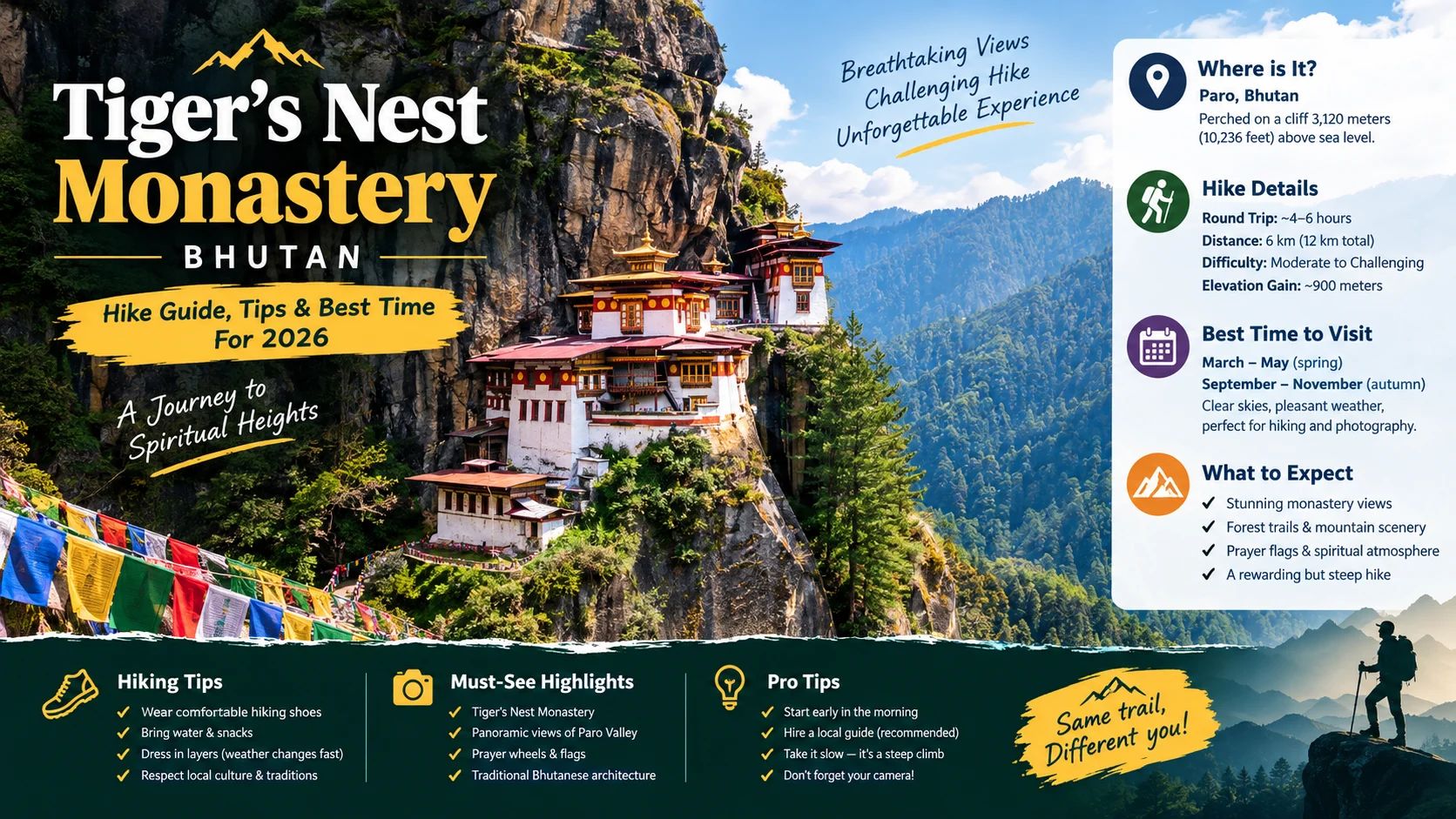

Tiger’s Nest Monastery is a cliffside Buddhist monastery in Bhutan’s Paro Valley. The hike is about 8 km (5 miles) round trip, takes around 4–6 hours, and climbs approximately 900 meters to the monastery at 3,120 meters above sea level.
If there is one place that captures the spiritual and natural beauty of Bhutan, it is Tiger’s Nest Monastery.
Also known as Paro Taktsang, this legendary monastery clings to a dramatic cliff above the Paro Valley. Reaching it requires a steep mountain hike through pine forest, prayer flags, stone steps, and spectacular Himalayan scenery.
But how difficult is the hike? How long does it take? When should you go? And what should you know before visiting?
Here’s a practical guide to help you plan the Tiger’s Nest Monastery Bhutan experience.
Tiger’s Nest Monastery Quick Facts


| Feature | Quick Facts |
|---|---|
| Location | Paro Valley, Bhutan |
| Monastery Elevation | About 3,120 m (10,236 ft) |
| Trail Distance | Approximately 8 km / 5 miles round trip* |
| Elevation Gain | Around 900 m / 2,950 ft* |
| Difficulty | Moderate to strenuous |
| Typical Time | About 4–6 hours round trip |
| Best For | Hiking, culture, spirituality, photography |
| Must Visit | Tiger’s Nest viewpoint & monastery |
*Trail distance and time can vary with the route, starting point, pace, and conditions. Bhutan’s tourism authorities describe the trail from the base as roughly 4 km one way and around two hours each way.
What Is Tiger’s Nest Monastery?


Tiger’s Nest, officially Taktsang Palphug Monastery, is one of Bhutan’s most important Buddhist sites.
The monastery complex sits dramatically on a cliff at approximately 3,120 meters above sea level, around 900 meters above the Paro Valley. Bhutan’s tourism authorities describe Taktshang as one of the country’s most revered cultural sites.
The site is traditionally associated with Guru Rinpoche (Padmasambhava), who is believed to have arrived here in the 8th century. According to Bhutanese tradition, he flew to the location on the back of a tigress, giving the site its famous name, Tiger’s Nest.
The present monastery was constructed in 1692.
Tiger’s Nest Hike: What Is the Trail Like?


The hike begins near the base of the mountain above Paro Valley.
The first section climbs gradually through forest. You’ll walk beneath pine trees while the monastery occasionally appears between the branches and cliffs.
The trail then becomes steeper, with sections of stone and uneven ground.
A typical journey can be thought of in three stages:
Base → Cafeteria/viewpoint → Waterfall → Monastery
The exact experience varies depending on your pace and where you take breaks.
Quick Facts
- Distance: Approximately 8 km round trip
- Elevation gain: Around 900 m
- Difficulty: Moderate to strenuous
- Time: Roughly 4–6 hours
- Best for: Hikers and cultural travelers
- Must visit: Main monastery complex and waterfall section
The Bhutan tourism authority describes the climb to the monastery as roughly two hours one way, while other official tourism material describes the overall hike as around four hours. Individual timing can be longer with sightseeing and rest stops.
The Famous Tiger’s Nest Viewpoint


One of the most rewarding moments comes when the monastery finally appears across the valley.
From the viewpoint, you can see the white-and-gold buildings seemingly attached to the vertical rock face.
This is also one of the best places to pause, catch your breath, and appreciate just how dramatic the location is.
Must Visit: Stop at the viewpoint before continuing toward the monastery. The perspective gives you one of the classic views of Paro Taktsang.
Waterfall and Final Approach


After the main viewpoint, the trail descends before climbing again toward the monastery.
A waterfall and prayer-flag-covered area make this section especially atmospheric.
You’ll then encounter a series of steps as the trail approaches the monastery.
This final section can feel surprisingly demanding because you have already climbed a significant amount before reaching it.
Take your time rather than trying to rush the final ascent.
Visiting the Monastery


Tiger’s Nest is a living religious site, not simply a scenic attraction.
Visitors should dress respectfully and follow instructions from guides and monastery staff.
Bhutan Tourism specifically asks visitors to respect sacred places and religious items. Photography restrictions may apply inside religious buildings, so always follow the current rules rather than assuming cameras are allowed.
Allow enough time to appreciate the monastery instead of treating the hike as simply a race to the summit.
Best Time to Visit Tiger’s Nest


The best conditions depend on whether you prioritize weather, scenery, crowds, or a quieter experience.
Spring: Green landscapes and pleasant hiking conditions can make this an attractive period.
Autumn: Often offers clear mountain views and comfortable hiking temperatures.
Winter: Bhutan Tourism notes that winter can provide calmer trails and clearer views, although temperatures are colder.
Monsoon: Rain can make mountain trails wet and slippery, so conditions should be checked before setting out.
For any season, start early enough to give yourself plenty of time for the climb, monastery visit, and descent.
What to Pack for the Tiger’s Nest Hike


You don’t need technical mountaineering equipment, but comfortable hiking gear makes a big difference.
Recommended Packing List
- Comfortable hiking shoes with good grip
- Reusable water bottle
- Light snacks
- Sunscreen
- Sunglasses
- Hat
- Lightweight layers
- Rain jacket
- Small backpack
- Walking poles if useful for you
- Camera or phone
- Some cash for local purchases
Because the trail climbs significantly, avoid carrying an unnecessarily heavy backpack.
Do You Need a Guide for Tiger’s Nest?
Bhutan’s tourism guidance states that visitors should be accompanied by a certified local guide while travelling in Bhutan.
A guide can also add cultural context to the monastery and help visitors understand local etiquette.
This is particularly useful at a sacred site where appropriate behavior matters as much as reaching the destination.
Bhutan Visa and Sustainable Development Fee


Planning the Tiger’s Nest hike also means planning your entry into Bhutan.
For most international visitors, Bhutan currently requires a visa. Bhutan Tourism states that the visa application fee is US$40, while the Sustainable Development Fee (SDF) is generally US$100 per adult per day, with concessions for children. Different rules apply to visitors from India, Bangladesh, and the Maldives.
Because visa and SDF policies can change, check the official Bhutan Tourism information before booking.
Tiger’s Nest Hike Difficulty
Difficulty: Moderate to strenuous
The hike isn’t technically a climbing route, but the elevation gain makes it physically demanding.
The main challenges are:
- Steady uphill climbing
- Around 900 m of elevation gain
- Numerous steps
- High elevation
- Potential heat or rain
- A steep descent after reaching the monastery
You don’t need to be an elite athlete, but you should be comfortable with several hours of uphill walking.
If you need breaks, take them. The goal is to enjoy the journey rather than finish as quickly as possible.
Tiger’s Nest Hike Comparison
| Feature | Tiger’s Nest Monastery Hike |
|---|---|
| Distance | ~8 km / 5 mi round trip* |
| Elevation Gain | ~900 m / 2,950 ft* |
| Time | ~4–6 hours |
| Difficulty | Moderate–Strenuous |
| Highest Point | ~3,120 m |
| Trail Type | Mountain path, stairs & uneven terrain |
| Main Attraction | Paro Taktsang |
| Best Experience | Culture + hiking + scenery |
*Approximate figures; official Bhutan sources describe the base-to-monastery trail as about 4 km one way.
Tiger’s Nest Hiking Tips


Start early: Cooler temperatures can make the climb more comfortable.
Pace yourself: The trail gains substantial elevation, so avoid rushing.
Wear proper shoes: Some sections are steep and uneven.
Respect the monastery: Dress appropriately and follow photography rules.
Carry water: Hydration is important at altitude.
Check weather: Rain can affect trail conditions and visibility.
Stay on the trail: Avoid shortcuts and respect the surrounding environment.
Listen to your body: If you feel unwell at altitude, slow down and seek appropriate assistance.
FAQs
How long is the Tiger’s Nest hike?
The round-trip hike is commonly described as approximately 8 km, with official Bhutan tourism information giving roughly 4 km from the base to the monastery.
How long does Tiger’s Nest take?
Many visitors should allow around 4–6 hours for the hike, monastery visit, breaks, and return journey. Individual times vary.
How high is Tiger’s Nest Monastery?
Paro Taktsang sits at approximately 3,120 meters (10,236 feet) above sea level.
Is Tiger’s Nest difficult?
It is generally considered a moderate-to-strenuous hike because of the approximately 900-meter elevation gain, steep sections, stairs, and altitude.
Can beginners hike Tiger’s Nest?
Yes, people with different hiking backgrounds visit Tiger’s Nest, but beginners should allow plenty of time and pace themselves. The climb is physically demanding rather than technically difficult.
What is Tiger’s Nest also called?
Tiger’s Nest is commonly known as Paro Taktsang or Taktsang Palphug Monastery.
When is the best time to hike Tiger’s Nest?
Spring and autumn are popular for hiking conditions and scenery, while Bhutan Tourism notes that winter can offer calmer trails and clear views.
Final Thoughts
Tiger’s Nest Monastery Bhutan is more than a famous Himalayan viewpoint.
The climb through pine forests, prayer flags, steep mountain paths, and dramatic cliffs leads to one of Bhutan’s most important spiritual landmarks.
With approximately 900 meters of elevation gain and a round-trip journey that can take several hours, it deserves preparation but the combination of culture, scenery, and pilgrimage makes the experience distinctive.
Take your time, respect the sacred site, check conditions before hiking and enjoy the journey as much as the destination.
