
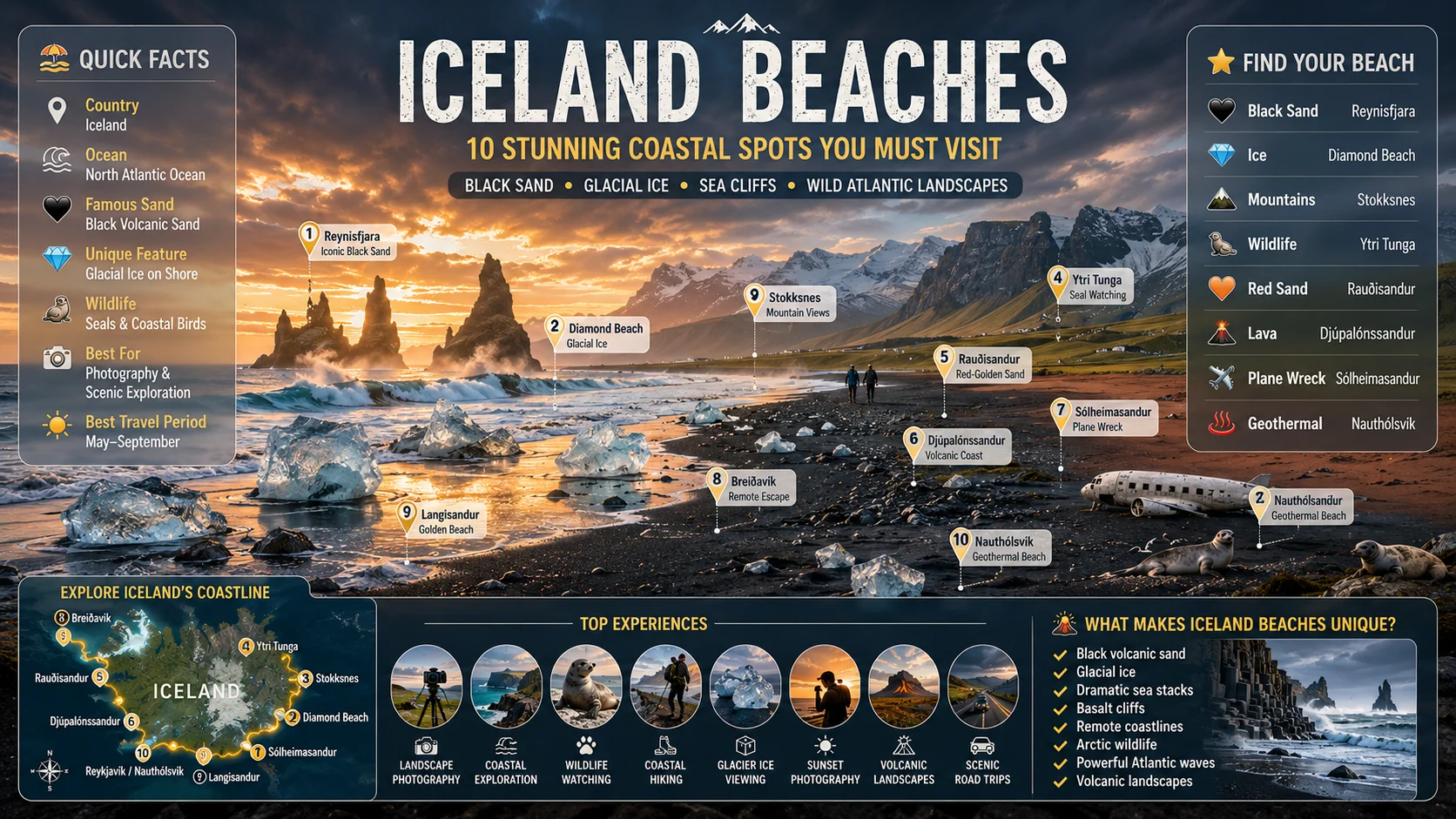

Iceland beaches are famous for dramatic black sand, powerful Atlantic waves, towering cliffs, sea stacks, and volcanic landscapes. The best beaches to visit include Reynisfjara, Diamond Beach, Stokksnes, Ytri Tunga, Rauðisandur, and Djúpalónssandur.
Forget everything you imagine when you hear the word beach.
Iceland’s coastline is not mainly about tropical water, palm trees, or sun loungers. Instead, its beaches offer something much more dramatic: black volcanic sand, icebergs drifting toward shore, towering basalt cliffs, golden sands, remote coves, and wild Atlantic scenery.
Some Iceland beaches feel almost otherworldly. At Diamond Beach, chunks of glacier ice sparkle against dark volcanic sand. At Reynisfjara, enormous waves crash beneath towering basalt formations. On the Snæfellsnes Peninsula, beaches can combine lava fields, cliffs, mountains, and the open ocean in a single view.
If you’re planning a trip around Iceland’s Ring Road or South Coast, these 10 Iceland beaches are worth adding to your itinerary.
Quick Facts About Iceland Beaches
| Feature | Details |
|---|---|
| Country | Iceland |
| Surrounding Waters | North Atlantic Ocean, Arctic waters |
| Famous Beach Type | Black volcanic sand |
| Other Beach Types | Golden, red, white, pebble and rocky shores |
| Most Iconic Beach | Reynisfjara |
| Famous Ice Beach | Diamond Beach |
| Best For Wildlife | Ytri Tunga |
| Best For Photography | Stokksnes |
| Best Time to Visit | May–September for easier travel |
| Winter Attraction | Dramatic scenery and fewer visitors |
| Main Activities | Photography, sightseeing, hiking, wildlife viewing |
1. Reynisfjara Beach — The Iconic Black-Sand Beach
If you visit only one beach in Iceland, Reynisfjara deserves serious consideration.
Located near Vík on Iceland’s South Coast, Reynisfjara is famous for its striking black volcanic sand, enormous basalt columns, sea caves, and offshore Reynisdrangar sea stacks.
The contrast is spectacular: dark sand below, dramatic cliffs behind you, and the powerful North Atlantic stretching toward the horizon.
Why Visit Reynisfjara?
- 🖤 Famous black volcanic sand
- 🪨 Dramatic basalt formations
- 🌊 Powerful Atlantic waves
- 🏔 Reynisdrangar sea stacks
- 📸 Exceptional photography opportunities
- 🚗 Convenient South Coast location
⭐ Attraction Point
The Reynisdrangar sea stacks are the beach’s signature feature. According to Icelandic folklore, they are trolls turned to stone after being caught by sunlight.
⚠️ Important Safety Note
Reynisfjara is beautiful but can be dangerous because of powerful sneaker waves. Never turn your back on the ocean or stand too close to the water.
2. Diamond Beach — Where Ice Meets Black Sand
Diamond Beach is one of the most unusual coastal landscapes in Iceland.
Located near Jökulsárlón Glacier Lagoon, the beach gets its name from chunks of glacial ice that wash onto the black volcanic sand. Depending on conditions, you may see pieces ranging from small crystal-like fragments to enormous blocks of blue and transparent ice.
Why Visit Diamond Beach?
- 💎 Ice chunks resemble diamonds
- 🖤 Contrasting black sand
- 🧊 Glacier ice along the shoreline
- 📸 Incredible photography
- 🌊 Directly connected to the Atlantic Ocean
⭐ Attraction Point
The biggest attraction is the constantly changing ice. No two visits necessarily look the same.
This makes Diamond Beach particularly attractive for photographers looking for unusual natural scenes.
3. Stokksnes Beach — Black Sand Beneath Vestrahorn
Stokksnes is one of Iceland’s most photogenic coastal destinations.
The beach is backed by the dramatic Vestrahorn mountain, creating an extraordinary combination of dark sand, shallow water, dunes, and jagged mountain peaks.
Unlike many famous Iceland beaches, Stokksnes feels more expansive and cinematic.
Why Visit Stokksnes?
- 🏔 Vestrahorn mountain backdrop
- 🖤 Black volcanic sand
- 🌊 Reflective coastal water
- 🌾 Grass-covered dunes
- 📸 Excellent landscape photography
⭐ Attraction Point
Vestrahorn reflected in the coastal water can create one of the most memorable photographs of an Iceland trip.
Visit around sunrise or sunset for softer light and dramatic reflections.
4. Ytri Tunga Beach — A Wildlife Lover’s Favorite
Not every Iceland beach is black.
Ytri Tunga, located on the Snæfellsnes Peninsula, is known for its golden-colored sand and seal colonies.
Harbor seals and grey seals can often be spotted around the rocky shoreline, making this beach particularly interesting for wildlife enthusiasts.
Why Visit Ytri Tunga?
- 🦭 Seal watching
- 🏖 Golden sand
- 🌊 Rocky Atlantic coastline
- 📸 Wildlife photography
- 🌿 Peaceful natural setting
⭐ Attraction Point
The seals are the reason to come here.
Bring binoculars and maintain a respectful distance rather than approaching wildlife.
5. Djúpalónssandur Beach — A Dramatic Lava-Covered Shore
Djúpalónssandur is not a traditional sandy beach.
Located on the Snæfellsnes Peninsula, the shoreline is covered with smooth black volcanic stones and surrounded by dramatic lava formations.
The beach has a strong connection to Iceland’s maritime history, and remnants of an old shipwreck can still be seen along the coast.
Why Visit?
- 🖤 Black volcanic pebbles
- 🌋 Dramatic lava formations
- 🌊 Wild Atlantic scenery
- ⚓ Maritime history
- 📸 Unique landscape
⭐ Attraction Point
Look for the lifting stones, historically associated with testing the strength of fishermen.
Djúpalónssandur is especially rewarding for travelers who want a beach experience that feels completely different from a conventional seaside destination.
6. Rauðisandur Beach — Iceland’s Red-Sand Surprise
Rauðisandur proves that Iceland’s beaches aren’t all black.
Located in Iceland’s remote Westfjords, Rauðisandur is famous for its unusual reddish-golden sand, which creates a striking contrast with the surrounding mountains and blue-green ocean.
The remote location is part of the attraction.
Why Visit Rauðisandur?
- 🧡 Distinctive red-golden sand
- 🏔 Remote Westfjords scenery
- 🌊 Peaceful coastline
- 🦭 Wildlife opportunities
- 📸 Exceptional landscape photography
⭐ Attraction Point
The combination of red sand + mountains + ocean makes Rauðisandur one of Iceland’s most visually distinctive beaches.
If you want to escape the busiest tourist stops, this is a strong choice.
7. Breiðavík Beach — A Quiet Westfjords Escape
Breiðavík is another spectacular Westfjords beach for travelers seeking solitude.
The beach sits within a remote landscape where mountains meet the Atlantic, creating an atmosphere that feels far removed from Iceland’s major tourist routes.
Why Visit Breiðavík?
- 🏖 Wide coastal landscape
- 🏔 Dramatic mountains
- 🌊 Open Atlantic views
- 📸 Peaceful photography location
- 🚗 Excellent addition to a Westfjords road trip
⭐ Attraction Point
The biggest attraction is the feeling of isolation.
Breiðavík is ideal for travelers who prefer quiet landscapes over busy tourist attractions.
8. Sólheimasandur — The Beach with a Famous Plane Wreck
Sólheimasandur is one of Iceland’s most recognizable coastal landscapes.
The black-sand plain became internationally famous because of the abandoned DC-3 aircraft wreck, which has become a popular photography location.
The contrast between the weathered aircraft and enormous volcanic landscape creates an unforgettable scene.
Why Visit?
- ✈️ Famous aircraft wreck
- 🖤 Vast black-sand landscape
- 📸 Unique photography
- 🌊 Dramatic coastal environment
- 🥾 Memorable walking experience
⭐ Attraction Point
The DC-3 wreck is the main draw.
The surrounding landscape is extremely exposed, so weather conditions can make the walk uncomfortable or challenging.
9. Langisandur Beach — A Golden Beach Near Akranes
Langisandur offers a completely different experience from Iceland’s famous black beaches.
Located near Akranes in western Iceland, this long golden-sand beach provides beautiful views across the surrounding coastal landscape.
It’s also much closer to Reykjavík than many remote Iceland beaches.
Why Visit Langisandur?
- 🏖 Golden sand
- 🌊 Atlantic coastline
- 🚗 Easy access from Reykjavík region
- 🚶 Excellent for coastal walks
- 🌅 Beautiful views
⭐ Attraction Point
Langisandur is a good option when you want a relaxed beach walk without committing to a remote coastal journey.
10. Nauthólsvík Geothermal Beach — An Unusual Iceland Beach Experience
Want to experience something completely different?
Nauthólsvík Geothermal Beach is located in Reykjavík and features a synthetic lagoon where geothermal water creates warmer conditions than the surrounding ocean.
It’s not Iceland’s wildest beach, but it offers something unique: a more traditional beach experience in a country known for icy waters and volcanic landscapes.
Why Visit?
- ♨️ Geothermal water
- 🏖 Golden sand
- 🏙 Located in Reykjavík
- 🏊 Swimming opportunities
- 🌤 Relaxed atmosphere
⭐ Attraction Point
The combination of geothermal water and an Icelandic beach environment makes Nauthólsvík unlike the country’s remote Atlantic beaches.
Which Iceland Beach Should You Visit?
Not sure where to start? Use this quick guide.
| If You Want… | Visit |
|---|---|
| 🖤 Iconic black sand | Reynisfjara |
| 💎 Ice on the beach | Diamond Beach |
| 🏔 Mountain photography | Stokksnes |
| 🦭 Seals | Ytri Tunga |
| 🌋 Lava landscapes | Djúpalónssandur |
| 🧡 Red sand | Rauðisandur |
| ✈️ Plane wreck | Sólheimasandur |
| 🏖 Golden sand near Reykjavík | Langisandur |
| ♨️ Warm beach experience | Nauthólsvík |
| 🤫 Remote coastal scenery | Breiðavík |
Best Time to Visit Iceland Beaches
Your ideal travel season depends on what you want to experience.
Summer: June–August
Summer generally provides longer daylight hours and easier access to many coastal locations.
It’s particularly attractive for:
- Road trips
- Hiking
- Wildlife watching
- Photography
- Exploring remote beaches
Spring and Autumn
These seasons can offer fewer visitors and dramatic weather.
They are good choices if you want a quieter experience, but conditions can change quickly.
Winter
Iceland’s beaches can look spectacular under winter skies, especially when snow covers surrounding mountains.
However, winter driving and coastal weather require much greater preparation.
What Makes Iceland Beaches So Special?
Iceland’s beaches are different because several geological forces meet along its coastline.
Volcanic activity created the country’s dark sands and lava formations. Glaciers contribute enormous pieces of ice to coastal waters. Powerful Atlantic waves continually reshape the shoreline.
The result is a coastline where you can find:
- Black volcanic sand
- Golden beaches
- Red sand
- Basalt cliffs
- Sea stacks
- Glacial ice
- Lava fields
- Wildlife
- Dramatic mountains
That’s why exploring Iceland beaches feels more like discovering geological landscapes than simply visiting a place to swim.
Iceland Beach Safety Tips
Iceland’s coastline deserves respect.
Watch for Sneaker Waves
At beaches such as Reynisfjara, waves can travel much farther up the shore than expected.
Stay well back from the water.
Check Weather Conditions
Wind, waves, visibility, and road conditions can change quickly.
Wear Appropriate Clothing
Even during summer, coastal Iceland can be cold and windy.
Bring:
- Waterproof layers
- Warm clothing
- Sturdy shoes
- Gloves and hat when needed
- Windproof outer layers
Respect Wildlife
If you encounter seals or birds, observe them from a safe distance.
Follow Local Signs
If an area is closed or marked as dangerous, don’t cross the barrier for a photograph.
What to Pack for Iceland Beaches
A beach trip in Iceland requires very different gear from a tropical vacation.
Essential items include:
- Waterproof jacket
- Warm layers
- Waterproof trousers
- Hiking shoes
- Camera
- Extra batteries
- Binoculars for wildlife
- Reusable water bottle
- Snacks
- Sunscreen
- Gloves and hat during colder months
A tripod can also be useful for landscape photography, especially around sunset or low-light conditions.
Final Thoughts
The best Iceland beaches aren’t necessarily the ones where you’ll spend hours swimming.
They’re the places where volcanic sand meets crashing waves, glaciers meet the ocean, seals appear along quiet shores, and mountains rise dramatically behind the coastline.
Start with the iconic Reynisfjara and Diamond Beach, then go beyond the famous stops. Visit Stokksnes for mountain photography, Ytri Tunga for seals, Rauðisandur for unusual red sand, or Djúpalónssandur for volcanic scenery and maritime history.
Whether you’re planning a Ring Road adventure, a South Coast road trip, or a quieter journey through the Westfjords, Iceland’s coastline offers something far more memorable than an ordinary beach vacation.
The real question isn’t whether Iceland has beautiful beaches—it’s which extraordinary coastline you’ll explore first.
