
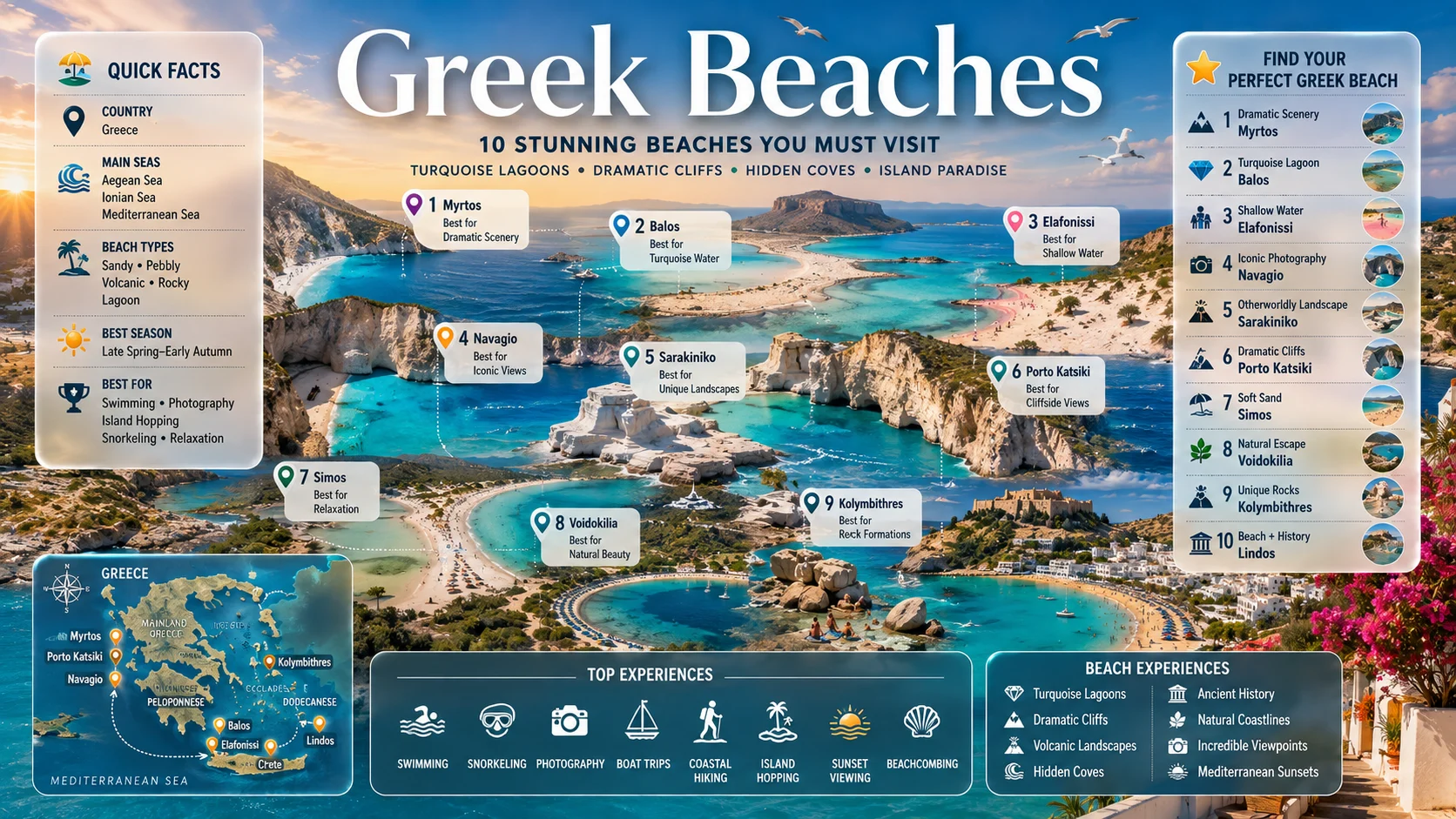

Greece is home to some of Europe’s most spectacular beaches, from the turquoise lagoons of Crete and dramatic cliffs of Kefalonia to Milos’s volcanic landscapes. The best Greek beaches include Myrtos, Balos, Elafonissi, Navagio, Sarakiniko, and Porto Katsiki, each offering a different coastal experience.
Imagine stepping onto a beach where the water shifts from deep blue to turquoise, white cliffs rise dramatically behind you, and the only thing competing with the sea is the view.
That’s the magic of Greek beaches.
Greece isn’t just about one type of coastline. You can find powdery sand, smooth white pebbles, volcanic rock, shallow lagoons, hidden coves, dramatic cliffs, and beaches backed by pine forests. The country’s official tourism site highlights everything from organized family-friendly shores to wild, secluded coastal landscapes.
But which beaches are actually worth putting on your itinerary?
This guide focuses on 10 must-visit Greek beaches, with a practical twist: instead of simply telling you they’re beautiful, we’ll explain what each beach is best for, what makes it different, and what you should know before going.
Quick Facts About Greek Beaches
| Feature | Details |
|---|---|
| Country | Greece |
| Main Seas | Aegean Sea, Ionian Sea, Mediterranean Sea |
| Beach Types | Sandy, pebbly, rocky, volcanic, lagoon |
| Water | Generally clear and blue to turquoise |
| Best Season | Late spring through early autumn |
| Best For | Swimming, photography, snorkeling, boating, relaxing |
| Top Beach Regions | Crete, Ionian Islands, Cyclades, Peloponnese |
| Popular Beach Islands | Crete, Kefalonia, Zakynthos, Milos, Lefkada |
| Ideal For | Couples, families, adventurers, photographers |
1. Myrtos Beach, Kefalonia — Best for Dramatic Scenery
If you want the kind of beach that makes you stop scrolling, Myrtos Beach belongs near the top of your list.
Located on Kefalonia, Myrtos is famous for its brilliant white pebbles, intensely blue Ionian water, and steep green mountains surrounding the coast. The elevated viewpoints above the beach are particularly impressive, giving visitors the classic postcard view of the curved shoreline.
The beach itself is beautiful, but the view from above is the real attraction.
The Greek National Tourism Organisation describes Myrtos as one of Kefalonia’s signature beaches, noting its white pebbles, turquoise water, and dramatic surrounding landscape.
Why visit?
- Incredible photography
- Clear Ionian water
- Dramatic mountain backdrop
- Scenic viewpoints
- Swimming and relaxing
⭐ Attraction Point: Don’t rush straight to the sand. Stop at the viewpoint first—the panoramic view of Myrtos is one of Kefalonia’s most memorable sights.
Best for: Couples, photographers, scenic road trips
2. Balos Beach & Lagoon, Crete — Best for Turquoise Water
Balos doesn’t look quite real.
Located in northwestern Crete, Balos Lagoon combines shallow turquoise water, pale sand, rocky mountains, and a distinctive lagoon landscape. The shallow water makes the area visually striking, while the surrounding Gramvoussa landscape adds another layer to the experience.
You can reach Balos by boat or by land, but the land route involves a demanding dirt-road and walking section. The official tourism site recommends carrying what you need because the beach is not fully organized like a conventional resort beach.
Why visit?
- Incredible turquoise lagoon
- Shallow water
- Dramatic mountain scenery
- Excellent photography
- Boat-trip opportunities
⭐ Attraction Point: Take a boat trip from Kissamos if you want to turn the journey itself into part of the experience.
Best for: Photographers, adventurers, couples
3. Elafonissi Beach, Crete — Best for Families & Shallow Water
Elafonissi is one of Crete’s most recognizable coastal landscapes.
Its shallow lagoon, pale sand, turquoise water, and subtle pink tones create a tropical-looking scene that feels far removed from the typical Mediterranean beach.
The beach sits on a peninsula connected to Crete by shallow water. The official tourism site notes that parts of the lagoon are no deeper than about one metre, making the area especially appealing for visitors looking for shallow water.
Why visit?
- Very shallow lagoon
- Turquoise water
- Pale and pink-tinted sand
- Family-friendly setting
- Beautiful dunes and natural surroundings
⭐ Attraction Point: Walk beyond the busiest section and explore the peninsula rather than staying in the first area you reach.
Best for: Families, casual swimmers, photographers
4. Navagio Beach, Zakynthos — Best for Iconic Views
Few Greek beaches are as instantly recognizable as Navagio Beach on Zakynthos.
The beach sits inside a dramatic limestone cove surrounded by towering cliffs, with the famous shipwreck creating the image that made Navagio internationally famous.
However, there’s an important 2026 update travelers should know.
Direct access to Navagio is currently restricted. Current 2026 information indicates that visitors cannot simply land on the beach, and restrictions around the cove are in place because of safety concerns related to the unstable cliffs. The exact rules can change, so travelers should verify the latest local restrictions before visiting.
That doesn’t make the destination irrelevant it simply changes the experience.
Why visit?
- Legendary shipwreck scenery
- Huge limestone cliffs
- Dramatic blue water
- One of Greece’s most photographed landscapes
- Excellent viewpoint opportunities
⭐ Attraction Point: Treat Navagio as a scenic attraction rather than a normal beach day unless authorities officially reopen access.
Best for: Photography, sightseeing, boat tours
5. Sarakiniko Beach, Milos — Best for Otherworldly Landscapes
If you’ve ever wondered what a beach on another planet might look like, Sarakiniko comes surprisingly close.
Located on Milos, Sarakiniko is known for its brilliant white volcanic rock formations sculpted by wind and waves. The bright rock contrasts sharply with the deep blue Aegean Sea.
Milos has more than 70 beaches and is particularly known for its unusual volcanic coastline. Official Greek tourism information highlights Sarakiniko’s white formations as one of the island’s defining natural attractions.
Why visit?
- Unique white rock formations
- Deep blue water
- Natural swimming areas
- Incredible photography
- Volcanic geological scenery
⭐ Attraction Point: Visit early or late in the day when the changing sunlight creates stronger shadows across the white rock.
Best for: Photographers, couples, explorers
6. Porto Katsiki, Lefkada — Best for Cliffside Views
Porto Katsiki is one of Lefkada’s signature beaches.
The combination of white cliffs, deep turquoise water, and a dramatic shoreline gives it the classic Greek-island look.
Lefkada is particularly convenient for road-trippers because the island can be reached from mainland Greece via a bridge rather than requiring a traditional ferry crossing. Its western coastline contains several famous beaches, including Porto Katsiki and Egremni.
Why visit?
- Spectacular cliffs
- Turquoise Ionian water
- Scenic coastal drives
- Swimming
- Photography
⭐ Attraction Point: Combine Porto Katsiki with other west-coast beaches on the same road trip rather than treating it as your only stop.
Best for: Road trips, couples, photographers
7. Simos Beach, Elafonisos — Best for Soft Sand & Relaxation
Simos Beach offers a different kind of Greek beach experience.
Located on the small island of Elafonisos in the southeastern Peloponnese, Simos is known for fine pale sand and remarkably clear cyan-colored water.
The beach is reached by a short ferry crossing from the mainland, and the surrounding lagoon-like waters can be particularly appealing to families. The official tourism site also notes the area’s camping options.
Why visit?
- Fine sand
- Clear cyan water
- Shallow lagoon-like areas
- Relaxed atmosphere
- Camping nearby
⭐ Attraction Point: Stay longer than a quick photo stop. Simos is better experienced slowly—with time for swimming, walking and relaxing.
Best for: Families, campers, relaxed travelers
8. Voidokilia Beach, Peloponnese — Best for Natural Beauty
Voidokilia is famous for its distinctive curved shoreline.
The beach forms an almost perfect crescent, surrounded by low hills and natural landscapes. Its shape makes it one of the most visually interesting beaches on mainland Greece.
This is a good choice if you want something beyond the classic island-resort experience.
Why visit?
- Iconic crescent shape
- Clear water
- Natural surroundings
- Excellent photography
- Peaceful coastal atmosphere
⭐ Attraction Point: Look beyond the beach itself and explore the surrounding landscape for elevated views of the crescent-shaped coast.
Best for: Nature lovers, photographers, day trips
9. Kolymbithres Beach, Paros — Best for Rock Formations
Paros brings a more polished Cycladic atmosphere to the list.
Kolymbithres Beach is especially interesting because of its smooth granite rock formations. Over time, wind and waves have sculpted the rocks into rounded shapes that divide the coastline into small coves.
Instead of one giant stretch of sand, you get a collection of intimate swimming areas.
Why visit?
- Sculpted granite formations
- Small coves
- Clear Aegean water
- Snorkeling opportunities
- Easy beach-hopping potential
⭐ Attraction Point: Explore the smaller coves instead of staying in the first section you see.
Best for: Couples, swimmers, photographers
10. Lindos Beach, Rhodes — Best for Beach + History
Want your beach day to include ancient history?
Lindos Beach gives you both.
The turquoise water and sandy shoreline sit beneath the dramatic landscape of Lindos, with the ancient Acropolis rising above the town. Greek tourism information specifically highlights the combination of turquoise waters and views toward the Lindos Acropolis.
That makes Lindos different from beaches that are purely about swimming.
Why visit?
- Beautiful turquoise water
- Sandy beach
- Ancient Acropolis nearby
- Scenic village
- Excellent photography
⭐ Attraction Point: Visit the beach and then explore Lindos village and the Acropolis for a full culture-and-coast experience.
Best for: History lovers, couples, photographers
Which Greek Beach Is Best for You?
Not every traveler wants the same thing from a beach.
| If You Want… | Go To |
|---|---|
| 🏆 Best overall scenery | Myrtos |
| 💎 Turquoise lagoon | Balos |
| 👨👩👧 Shallow water | Elafonissi |
| 📸 Iconic photography | Navagio |
| 🌋 Unique landscape | Sarakiniko |
| 🏔️ Dramatic cliffs | Porto Katsiki |
| 🏖️ Soft sand & relaxation | Simos |
| 🌿 Natural scenery | Voidokilia |
| 🪨 Unique rocks & coves | Kolymbithres |
| 🏛️ Beach + history | Lindos |
This is where choosing a beach becomes much easier: don’t ask only which beach is the most beautiful ask which experience you actually want.
Best Time to Visit Greek Beaches
The main beach season generally runs from late spring through early autumn, with July and August bringing the strongest summer demand.
If your priority is warm weather but fewer crowds, the shoulder seasons can be more appealing.
May–June
Excellent for sightseeing, road trips, hiking and beach exploration without the intensity of the peak summer period.
July–August
Best for travelers who want the classic hot Mediterranean summer atmosphere, but popular beaches can become extremely busy.
September
One of the strongest months for a beach-focused trip: warm conditions, sea temperatures that remain inviting, and potentially a more relaxed atmosphere than the busiest weeks of summer.
October
Still attractive in many parts of Greece, although weather and sea conditions become less predictable.
Pro tip: For famous beaches such as Balos and Elafonissi, visiting earlier in the day or during shoulder-season periods can make a major difference in the experience. Official tourism guidance also notes that Balos can become very busy during peak season.
Greek Beach Travel Tips
1. Check Access Before You Go
Some spectacular beaches require hiking, boat travel, dirt-road driving or stairs.
Porto Katsiki, for example, involves a descent to reach the shoreline, while Balos requires either a boat journey or a more demanding land approach.
2. Don’t Assume Every Beach Has Facilities
Some Greek beaches are highly organized with restaurants, umbrellas and services. Others are intentionally natural.
Bring:
- Water
- Sunscreen
- Hat
- Comfortable footwear
- Snacks
- Beach towel
- Waterproof bag
3. Check Current Beach Restrictions
Greece has increasingly emphasized protection of sensitive coastal areas. Certain beaches may have restrictions on commercial beach furniture or other services, so don’t assume that conditions from an older travel guide still apply.
4. Respect the Coast
Avoid removing shells, disturbing wildlife, walking through protected vegetation, or leaving plastic and food waste behind.
The most beautiful Greek beaches are also fragile ecosystems.
Why Greek Beaches Are Worth Visiting
The biggest attraction of Greek beaches isn’t simply the color of the water.
It’s the variety.
One day you can stand beside white volcanic cliffs in Milos. The next, you can swim beside dramatic mountains in Kefalonia. In Crete, you can explore shallow lagoons, while Lefkada offers huge Ionian cliffs and turquoise water.
That’s why a Greek beach trip doesn’t have to mean choosing one perfect shoreline.
You can build an entire itinerary around different coastal experiences.
Want dramatic scenery? Choose Myrtos.
Want a turquoise lagoon? Choose Balos.
Traveling with children? Look at shallow-water beaches such as Elafonissi or Simos.
Want something completely different? Go to Sarakiniko.
Want history with your swimming? Lindos delivers both.
Frequently Asked Questions
What is the most beautiful beach in Greece?
There is no single objective winner, but Myrtos, Balos, Elafonissi, Navagio and Sarakiniko are among the country’s most visually distinctive beaches.
Which Greek beach has the clearest water?
Many Greek beaches have exceptionally clear water. Balos, Elafonissi, Myrtos and Sarakiniko are particularly famous for their vivid blue and turquoise coastal scenery.
What is the best Greek beach for families?
Elafonissi and Simos are strong choices because of their shallow, lagoon-like waters and generally gentle beach environments. Always check local conditions before swimming.
Is Navagio Beach open?
Direct access to Navagio Beach is restricted in 2026, according to current reports. Visitors should check the latest official/local guidance before traveling because restrictions can change.
When is the best time to visit Greek beaches?
For warm beach weather, summer is the classic choice. For a combination of good weather and potentially fewer crowds, June and September can be especially attractive.
Are Greek beaches free?
Many beaches are publicly accessible, but facilities such as parking, sunbeds, umbrellas, beach clubs, and organized activities can vary by location. Protected beaches may also have additional restrictions.
Final Thoughts
The best Greek beaches aren’t all beautiful for the same reason.
Myrtos delivers dramatic Ionian scenery. Balos feels like a natural lagoon. Elafonissi is ideal for shallow-water exploration. Sarakiniko looks almost otherworldly, while Lindos adds ancient history to the beach experience.
So don’t build your Greek itinerary around a single “best beach.”
Build it around the experience you want.
And if you can only choose a few, start with Myrtos, Balos, Elafonissi, Sarakiniko, and Porto Katsiki then add a quieter beach such as Simos or Voidokilia for a change of pace.
That combination gives you the Greece most travelers are actually searching for: turquoise water, dramatic landscapes, unforgettable views, and beaches that feel completely different from one another.
