
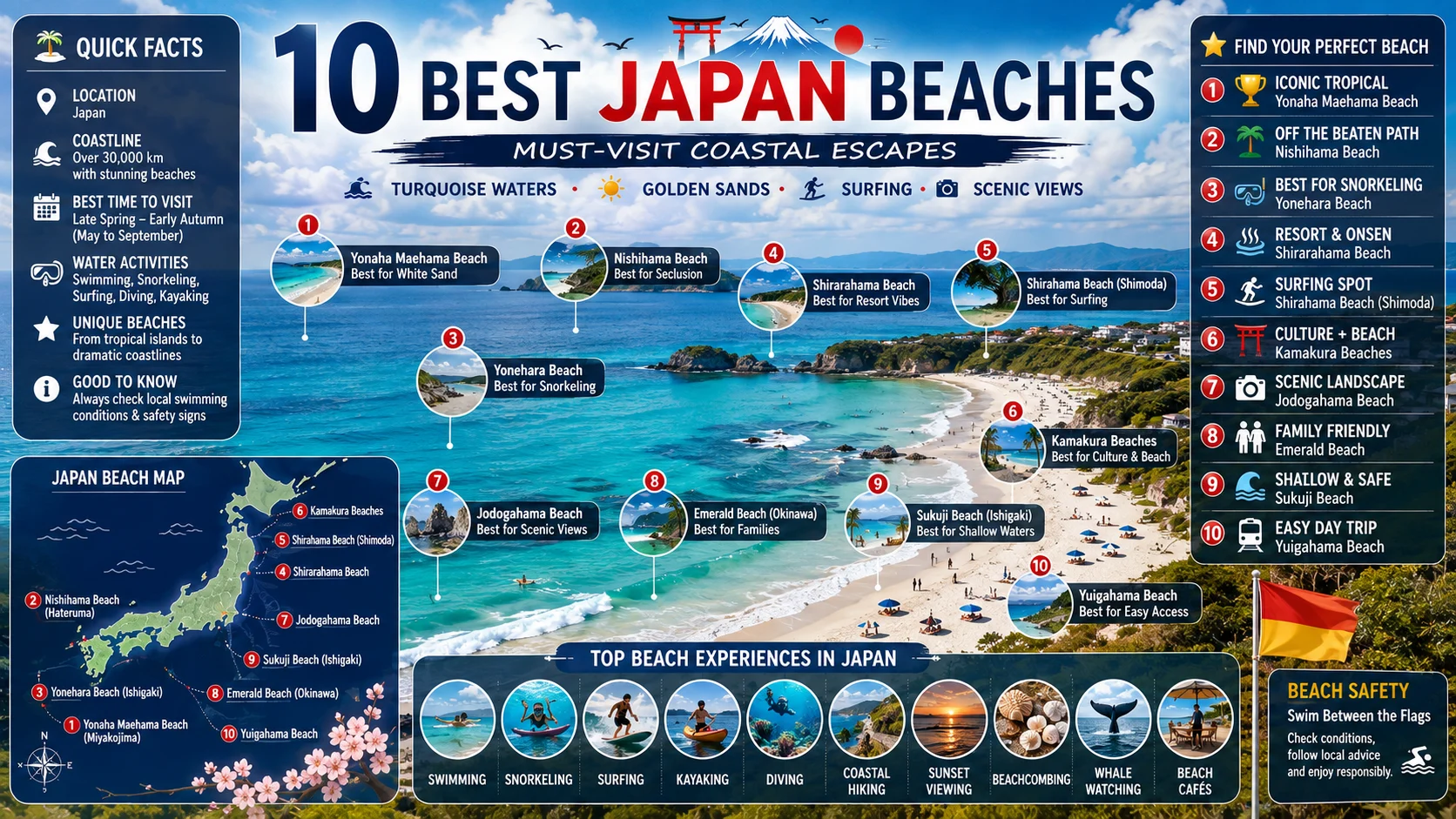

Japan beaches range from Okinawa’s white-sand tropical shores to Pacific surf beaches and dramatic northern coastlines. The best picks include Yonaha Maehama, Nishihama, Yonehara, Shirarahama, Kamakura, and Jodogahama, each offering a different beach experience.
Japan Beaches at a Glance
Japan may be better known for temples, mountains, cherry blossoms, and bustling cities, but its coastline tells a completely different story.
Travel south and you’ll find Okinawa’s translucent turquoise water, coral reefs, and tropical islands. Head toward central Japan and you’ll discover surf-friendly beaches close to major cities. Go farther north and the scenery becomes more rugged, with rocky coastlines, sheltered bays, and dramatic natural formations.
That variety makes Japan beaches surprisingly difficult to rank with a simple “best” list.
So instead of giving you ten beaches that all look alike, this guide matches each destination with the experience it does best.
Quick Facts
| Feature | Details |
|---|---|
| Country | Japan |
| Main Beach Regions | Okinawa, Kyushu, Kansai, Kanto, Tohoku |
| Best Tropical Beaches | Okinawa & surrounding islands |
| Best for Coral Reefs | Okinawa, Ishigaki, Miyakojima |
| Best for City Access | Kamakura |
| Best for Surfing | Kamakura, Izu, Okinawa |
| Best for Dramatic Scenery | Jodogahama |
| Best for White Sand | Yonaha Maehama, Shirarahama |
| Best Travel Period | Generally late spring through early autumn; local swimming seasons vary |
| Best for Island Escapes | Miyakojima, Ishigaki, Hateruma |
The big surprise: Japan’s most tropical-looking beaches are often far from Tokyo. If turquoise water and coral reefs are your priority, Okinawa should be near the top of your itinerary.
1. Yonaha Maehama Beach, Miyakojima — Best for White Sand and Turquoise Water


If your idea of a perfect Japanese beach involves powdery sand, brilliant turquoise water, and a tropical island atmosphere, Yonaha Maehama Beach is an excellent place to start.
Located on Miyakojima in Okinawa, the beach stretches for about 7 kilometers, giving visitors plenty of room to enjoy the shoreline. JNTO highlights its snorkeling and scuba diving opportunities as well as its spectacular sunsets.
The surrounding Miyako Islands are also known for coral reefs and clear emerald-colored seas, making the area much more than a simple sunbathing destination.
Best for: Swimming, snorkeling, diving, sunsets, couples
Must-do: Stay until sunset. The long western-facing beach gives you a memorable end to the day.
2. Nishihama Beach, Hateruma Island — Best for an Off-the-Beaten-Path Escape


Want a beach that feels far removed from Japan’s busy cities?
Nishihama Beach on Hateruma Island is the kind of destination to consider when your priority is quiet island scenery rather than crowds and nightlife.
Hateruma is part of the Yaeyama Islands, a remote island group in Okinawa known for beautiful beaches and secluded stretches of coastline. Okinawa’s official tourism guide specifically highlights the remote islands of the region for their pristine beaches and quieter natural surroundings.
Best for: Peace, photography, couples, remote island travel
Why visit: This is the choice for travelers who want the beach itself to be the destination.
3. Yonehara Beach, Ishigaki Island — Best for Coral Reefs and Snorkeling


Ishigaki Island is one of Japan’s strongest destinations for travelers who want beaches plus underwater adventures.
Yonehara Beach is particularly popular, while nearby Ishigaki coastlines offer access to coral-rich waters and marine environments. JNTO describes Ishigaki as a tropical destination with extensive coral reefs and several high-quality beaches.
For families, Sukuji Beach is another nearby option because of its shallow water and sandy seabed.
Best for: Snorkeling, coral reefs, marine life, island exploration
Must-do: Make snorkeling part of the trip rather than spending the entire day on the sand.
4. Shirarahama Beach, Wakayama — Best for a Classic Beach Resort


Shirarahama is one of the most recognizable beach destinations on Japan’s main island of Honshu.
Its curved shoreline features around 620–640 meters of white sand, depending on the official tourism source and measurement, with sparkling water and a resort atmosphere.
The attraction here isn’t just the beach.
Shirahama is also famous for Shirahama Onsen, a hot-spring destination with a history stretching back more than 1,350 years.
That combination makes this an easy destination to build into a longer trip.
Best for: Families, resorts, swimming, hot springs
Attraction bonus: Beach by day, onsen by evening.
5. Shirahama Beach, Shimoda — Best for Surfing and Clear Water


Don’t confuse this beach with Shirarahama in Wakayama.
Shirahama Beach in Shimoda, on the Izu Peninsula, is another standout coastal destination. JNTO describes it as a popular summer beach with clear water, regular surf, and more than 800 meters of sand.
Its proximity to Tokyo also makes it appealing for travelers who want a coastal escape without flying to Okinawa.
Best for: Surfing, swimming, weekend escapes, couples
Travel tip: The official swimming season begins in July, while favorable weather can extend the beach season from around June into mid-September.
6. Kamakura Beaches — Best for Beach + Japanese Culture


This is where a Japanese beach vacation becomes something much more interesting.
Kamakura is roughly an hour from Tokyo by train and offers several beaches, including Yuigahama, Zaimokuza, and Koshigoe.
You can spend the morning exploring temples and the famous Great Buddha, then head toward the coast for swimming, surfing, paddleboarding, or a relaxed seaside meal.
On clear days, Mt. Fuji can also be visible from the coastline.
Best for: Tokyo day trips, culture, surfing, photography
Must-do: Combine the beach with Kamakura’s historic sights instead of treating it as a standalone beach trip.
Best combination: Temple visit → Japanese lunch → beach → sunset.
7. Jodogahama Beach, Iwate — Best for Dramatic Scenery


Jodogahama is proof that Japan beaches don’t have to be tropical to be spectacular.
Located in Iwate and part of Sanriku Fukkō National Park, the beach features a sheltered bay, white pebbles, calm water, and striking rocky formations.
The area is particularly attractive for travelers who prefer landscapes over conventional resort beaches.
You can swim, hike along nearby trails, explore the rugged coastline, or take a boat tour toward the rock formations.
Best for: Photography, hiking, scenic drives, nature
Important: This is a pebble beach rather than a soft-sand beach, so suitable footwear is useful.
8. Emerald Beach, Okinawa — Best for a Family-Friendly Tropical Day


For travelers staying on Okinawa’s main island, Emerald Beach is an easy destination to consider when you want classic tropical scenery without traveling to a remote island.
The Okinawa region is particularly notable for its subtropical climate, white-sand beaches, coral reefs, and underwater ecosystems.
That makes Okinawa one of the strongest regions in Japan for travelers who want the visual feel of a tropical beach holiday.
Best for: Families, swimming, sightseeing, first-time Okinawa visitors
Must-do: Combine beach time with other Okinawa attractions rather than spending the entire trip at one shoreline.
9. Sukuji Beach, Ishigaki — Best for Shallow Water

Sukuji Beach is one of the more practical choices for families visiting Ishigaki.
According to JNTO, the beach sits in a graceful bay surrounded by trees, with shallow water and a sandy seabed, making it particularly suitable for visitors traveling with young children.
It also offers a different experience from Ishigaki’s more snorkeling-focused beaches.
Best for: Families, relaxed swimming, shallow water
Why it stands out: Not every beautiful beach is easy for families. Sukuji combines scenery with a more accessible swimming environment.
10. Yuigahama Beach, Kamakura — Best for a Convenient Coastal Day


If you want one of Japan’s beaches that is easy to combine with sightseeing, Yuigahama is hard to overlook.
It is close to Kamakura’s centre and within walking distance of several stations, making it convenient for visitors without a car. JNTO notes that the beach is particularly accessible and that summer brings beach cafés, food options, rental shops, and other seasonal services.
Best for: Tokyo-area travelers, first-time visitors, summer beach trips
Must-do: Pair Yuigahama with Kamakura’s temples and historic streets.
Which Japan Beach Is Best for You?
| Your Travel Goal | Best Choice | Why |
|---|---|---|
| Tropical paradise | Yonaha Maehama | Long white-sand shoreline and turquoise water |
| Snorkeling | Yonehara | Coral-rich Ishigaki environment |
| Family swimming | Sukuji | Shallow water and sandy seabed |
| Surfing | Shirahama, Shimoda | Clear water and regular surf |
| Culture + beach | Kamakura | Historic city and coastline |
| Dramatic scenery | Jodogahama | Rocky formations and sheltered bay |
| Luxury resort feel | Shirarahama | Beach + resort + onsen |
| Remote escape | Nishihama | Quiet Yaeyama island setting |
| Tokyo day trip | Yuigahama | Convenient access from Kamakura |
| Okinawa experience | Emerald Beach | Tropical scenery on the main island |
Best Time to Visit Japan Beaches
There isn’t one perfect beach season for the entire country.
Japan’s beaches vary considerably by latitude and region.
For many mainland destinations, the main swimming period falls in summer. Kamakura’s official beach season, for example, runs from July 1 through August 31.
Shirahama Beach in Shimoda generally has favorable beach weather from around June through mid-September, while its official swimming season begins in July.
Okinawa offers a much longer warm-weather window, although exact swimming periods, lifeguard coverage, and beach facilities vary by location and weather conditions.
The key lesson?
Don’t judge Japan’s entire beach season by Tokyo’s weather.
If warm water is your priority, look south toward Okinawa.
Japan Beach Safety Tips
A beautiful shoreline doesn’t automatically mean safe swimming conditions.
Before entering the water:
- Check local beach notices.
- Follow lifeguard instructions.
- Swim only in designated areas when possible.
- Check weather and wave conditions.
- Be aware that swimming seasons and lifeguard services vary.
- Take extra care around rocks, currents, and unfamiliar coastal areas.
- Follow local rules regarding alcohol, smoking, fires, and waste.
JNTO notes that many Japanese beaches provide more services during their official swimming seasons, including lifeguards, beach huts, rentals, and water-sports facilities. Outside those periods, services may be reduced or unavailable.
In Okinawa, jellyfish can also be a seasonal concern. Some beaches use protective nets, but conditions and precautions vary by location.
What to Pack for Japan Beaches
Keep your beach bag simple:
- Sunscreen
- Hat and sunglasses
- Swimwear
- Quick-dry towel
- Reusable water bottle
- Waterproof phone pouch
- Comfortable sandals
- Snorkeling equipment where appropriate
- Light jacket for changing coastal weather
- Small daypack for hikes
If you’re visiting a remote island, check what facilities are actually available before leaving your accommodation. Some secluded beaches don’t offer the convenience of major resort areas.
Why Japan Beaches Are Different
The best thing about exploring Japan beaches is the variety.
One day, you can swim in tropical Okinawan water surrounded by coral reefs. Another day, you can stand beside rugged rock formations in Iwate. Or you can take a train from Tokyo to Kamakura, visit historic temples, and finish the afternoon beside the Pacific.
That combination is what makes Japan’s coastline worth exploring.
Final Thoughts
Japan’s beaches aren’t defined by one look.
Yonaha Maehama delivers tropical island beauty. Yonehara brings coral reefs and snorkeling. Kamakura combines culture with the sea. Shirahama offers a classic resort experience, while Jodogahama delivers something completely different with its dramatic rocky coastline.
So don’t ask only, “What is the most beautiful beach in Japan?”
Ask:
“What kind of beach experience do I want?”
Choose the answer first, then choose your coastline.
That simple approach can turn a generic Japan trip into a much more memorable coastal adventure.
