
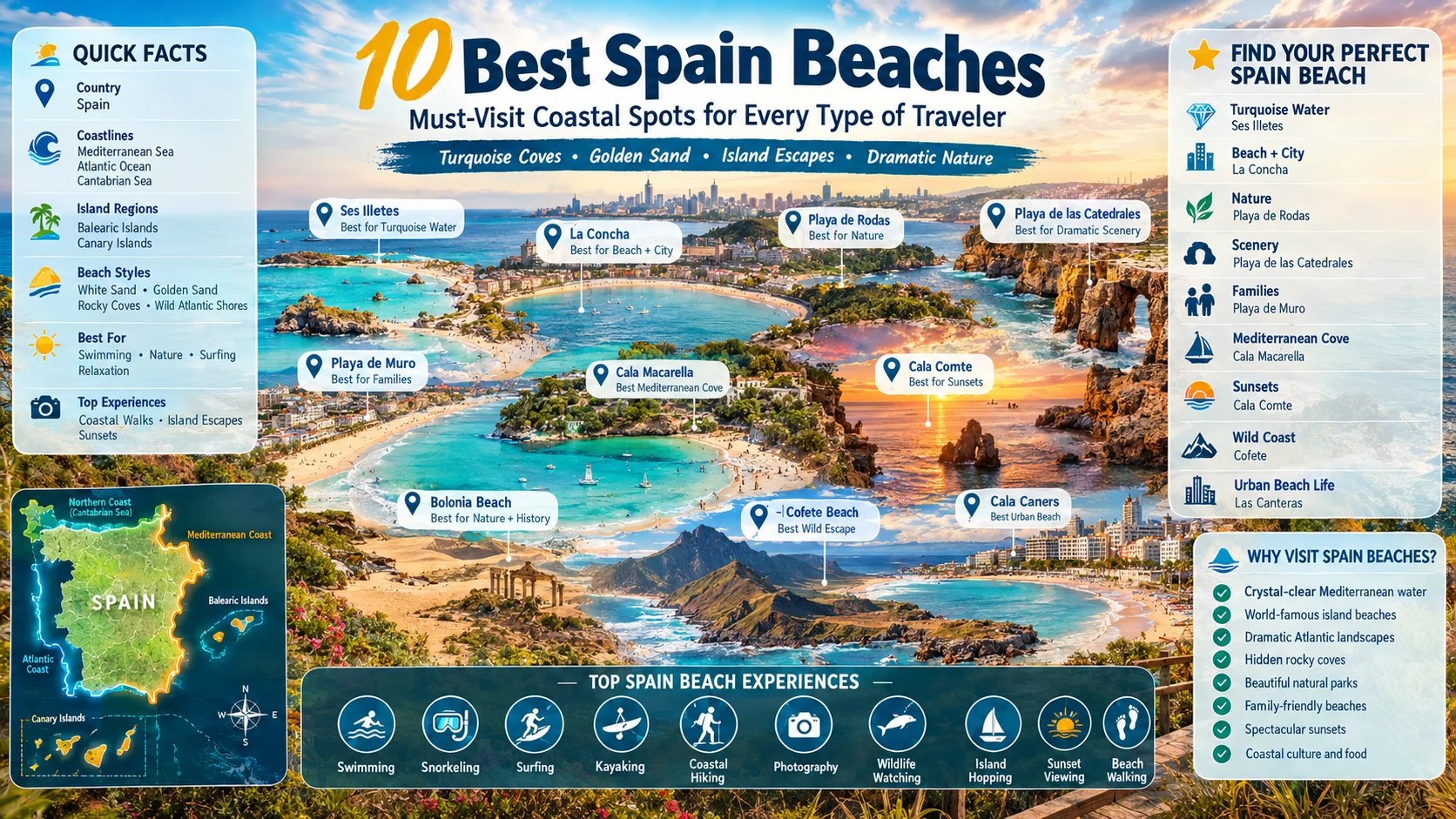

Spain beaches offer extraordinary variety, from turquoise Mediterranean coves and white-sand islands to wild Atlantic shores and dramatic rock formations. These 10 destinations stand out for scenery, swimming, nature, culture, and unforgettable coastal experiences.
Spain has nearly 8,000 kilometres of coastline, stretching across the Mediterranean, Atlantic and Cantabrian coasts, plus the Balearic and Canary Islands. That means there is no single “typical” Spanish beach. You can spend one trip swimming in calm turquoise water and another standing beneath enormous Atlantic rock arches.
The real question isn’t simply “What are the best beaches in Spain?”
It’s:
“Which Spanish beach gives me the experience I actually want?”
Want Caribbean-style water? Head towards Formentera.
Want dramatic natural scenery? Galicia is hard to ignore.
Want a wild and remote coastline? Fuerteventura delivers.
Want a beach with history, food and city life nearby? La Concha is an outstanding choice.
Spain Beaches at a Glance
| Beach | Region | Best For | Beach Style |
|---|---|---|---|
| Ses Illetes | Formentera | Turquoise water | Island paradise |
| La Concha | San Sebastián | City + beach | Urban bay |
| Playa de Rodas | Cíes Islands | Nature | Protected island |
| Playa de las Catedrales | Galicia | Dramatic scenery | Rock formations |
| Playa de Muro | Mallorca | Families | Long sandy beach |
| Cala Macarella | Menorca | Relaxation | Mediterranean cove |
| Cala Comte | Ibiza | Sunsets | Rocky turquoise coast |
| Bolonia Beach | Cádiz | Nature + history | Wild Atlantic beach |
| Cofete Beach | Fuerteventura | Remote landscapes | Wild volcanic coast |
| Las Canteras | Gran Canaria | City beach life | Urban beach |
1. Ses Illetes Beach — Best for Turquoise Water
If your idea of a perfect beach involves white sand and water so clear it almost looks unreal, Ses Illetes should be near the top of your Spain beach list.
Located on Formentera, this beach is famous for its brilliant turquoise water and open island scenery. Spain’s official tourism website specifically highlights Ses Illetes as a beach where the journey itself on foot or by bike adds to the experience.
The setting feels different from mainland Spain. Instead of a large urban coastline, you get an open, low-lying island landscape surrounded by bright Mediterranean water.
Best for: Swimming, couples, photography, relaxation
Don’t miss: Exploring nearby sections of the coastline by bike.
Why visit?
Because this is one of those beaches where the water itself becomes the main attraction.
2. La Concha Beach — Best for a Beach + City Experience
Not every great beach requires escaping civilisation.
La Concha Beach in San Sebastián proves that you can have beautiful sand, an impressive bay, excellent food and a major city experience in the same destination.
The beach sits within one of Spain’s best-known urban coastal settings, with Santa Clara Island visible from the bay. Spain’s official tourism site describes La Concha as one of the country’s standout urban beaches and highlights the surrounding promenade and city coastline.
This makes La Concha particularly appealing if you’re travelling with people who don’t want to spend an entire holiday lying on the sand.
Best for: Food lovers, city breaks, couples, walking
Don’t miss: Walking the waterfront promenade and exploring San Sebastián’s food scene.
Travel Hook: You can spend the morning on the beach and the evening exploring one of Spain’s great food cities.
3. Playa de Rodas — Best for Nature Lovers
Playa de Rodas is the kind of beach that makes travellers stop and question whether they’re still in Europe.
Located in the Cíes Islands off the coast of Galicia, Rodas combines white sand, clear water and protected island landscapes. The islands are part of a protected natural environment, and Spain’s tourism authority regularly highlights Rodas as one of the country’s standout beaches.
The beach connects parts of the Cíes island landscape and is surrounded by green hills and Atlantic scenery.
Because this is a protected destination, visitors should check current access and transport requirements before travelling.
Best for: Nature, hiking, photography, beach escapes
Don’t miss: Exploring the island beyond the main beach.
Why it stands out:
Rodas offers the rare combination of a bright sandy beach and a much wilder natural environment.


4. Playa de las Catedrales — Best for Dramatic Scenery
Playa de las Catedrales is not a typical “swim all day” beach.
And that’s exactly why it deserves to be here.
Located near Ribadeo in Galicia, this coastline is famous for enormous natural rock arches that become accessible at low tide. Spain’s official tourism information describes the arches as the feature behind the beach’s famous “Cathedrals” name.
The experience is all about timing.
At low tide, visitors can explore beneath and around dramatic formations. As the tide rises, the landscape changes completely.
Best for: Photography, nature, couples, dramatic landscapes
Important: Check tide conditions and current visitor rules before planning your visit.
Catchy Travel Moment: This is the beach to visit when you want to walk through scenery that looks more like a natural monument than a traditional coastline.
5. Playa de Muro — Best for Families
If your ideal Spain beach has space, soft sand and calmer-looking Mediterranean surroundings, Playa de Muro in Mallorca deserves attention.
The long sandy coastline and shallow-looking turquoise water make this part of Mallorca especially attractive for relaxed beach holidays.
Unlike a small rocky cove, Playa de Muro gives visitors room to spread out and enjoy a longer beach day.
Best for: Families, swimming, long beach walks
Don’t miss: Exploring more of Mallorca beyond the beach.
Why families like it:
A long sandy beach usually gives you more flexibility than smaller, crowded coves.
6. Cala Macarella — Best for a Classic Mediterranean Cove
Cala Macarella looks almost designed for travel photography.
Located on Menorca, the cove is surrounded by rocky cliffs and Mediterranean vegetation, while clear water fills the sheltered bay.
Spain’s official tourism site identifies Cala Macarella as one of Menorca’s most famous coves and notes that visitors can continue toward nearby Macarelleta if they want to explore further.
This is not the destination for someone looking for a huge urban beachfront.
It’s for travellers chasing that classic image of the Mediterranean: cliffs, boats, turquoise water and a sheltered cove.
Best for: Couples, swimming, photography, relaxation
Don’t miss: Exploring the surrounding coastal landscape.
7. Cala Comte — Best for Ibiza Sunsets
Ibiza is often associated with nightlife, but beaches such as Cala Comte show another side of the island.
Clear turquoise water, rocky surroundings and open sea views make it particularly attractive for people who want to experience Ibiza’s natural coastline.
The atmosphere changes beautifully later in the day, making sunset one of the strongest reasons to visit.
Best for: Sunset watching, swimming, couples, photography
Best time: Late afternoon into sunset.
Travel Hook: Visit for the water. Stay for the sky.
8. Bolonia Beach — Best for Nature and History
Bolonia Beach in Cádiz offers something many famous beaches can’t: a sense of open space.
Spain’s official tourism site highlights its extensive sand dunes and recommends experiencing the beach around sunset.
The beach has a wilder atmosphere than heavily developed Mediterranean resort areas.
That makes Bolonia a strong choice for travellers who want more natural scenery and fewer urban distractions.
The wider area also adds historical interest, giving you more reasons to explore beyond the shoreline.
Best for: Nature, long walks, history, sunsets
Don’t miss: The dunes and the changing evening light.
9. Cofete Beach — Best for a Wild Escape
Cofete Beach is for travellers who don’t need a beach to feel comfortable.
Located on Fuerteventura, this coastline feels remote, dramatic and open. Spain’s official tourism site describes Cofete as one of the Canary Islands’ best-known unspoilt beaches.
Instead of beach clubs and busy promenades, the visual identity here is dominated by sand, ocean and rugged mountains.
It feels raw.
It feels isolated.
And that is exactly the appeal.
Best for: Adventure, photography, dramatic landscapes
Good to know: Wild beaches can have stronger and less predictable conditions than sheltered swimming beaches.
Travel Hook: If your favourite beach photo involves mountains, Atlantic waves and almost endless sand, Cofete is the one to remember.
10. Las Canteras Beach — Best for Year-Round Beach Life
Las Canteras in Gran Canaria gives you something different again: a beach that feels connected to city life.
Spain’s official tourism website highlights Las Canteras for its location close to the city and its favourable conditions throughout much of the year.
That makes it a strong option for travellers who don’t want to choose between restaurants, city exploration and beach time.
You can build a full day around the coastline without needing to disappear into an isolated resort.
Best for: Urban travellers, swimming, longer stays, food and beach life
Why visit?
Because the beach feels like part of the city rather than a separate attraction.
Which Spain Beach Is Best for You?
| Your Travel Goal | Best Choice |
|---|---|
| Turquoise water | Ses Illetes |
| Beach + city | La Concha |
| Protected nature | Playa de Rodas |
| Dramatic scenery | Playa de las Catedrales |
| Family beach holiday | Playa de Muro |
| Mediterranean cove | Cala Macarella |
| Sunset | Cala Comte |
| Nature + history | Bolonia |
| Wild landscapes | Cofete |
| Year-round beach lifestyle | Las Canteras |
Best Time to Visit Spain Beaches
There is no single best month for every Spanish beach.
The Mediterranean coast and Balearic Islands are especially popular during the warmer months, while the Canary Islands offer a different year-round climate and are often considered for beach travel outside mainland Spain’s peak summer period.
Spain’s enormous geographical variety is the advantage.
You can choose your beach based on the season rather than assuming every part of the country has the same weather.
Summer
Best for:
- Swimming
- Island holidays
- Beach clubs
- Longer beach days
The downside is that famous destinations can become crowded.
Spring and Autumn
Best for:
- Coastal walks
- Photography
- City + beach trips
- Exploring without peak summer crowds
Winter
The Canary Islands become particularly interesting for travellers looking for milder conditions, while mainland beach experiences become more focused on scenery, walks and coastal culture.
Spain Beach Safety Tips
A beautiful beach does not always mean calm conditions.
Before swimming:
- Check local flags and warnings.
- Watch for currents and changing tides.
- Be especially careful on Atlantic beaches.
- Check low-tide times at beaches such as Playa de las Catedrales.
- Avoid assuming that every famous beach is ideal for swimming.
- Follow local access rules in protected areas.
For Spain beaches, conditions matter as much as scenery.
Final Thoughts
Spain doesn’t have one “best” beach because its coastlines are too different.
If you want the classic turquoise-water dream, start with Ses Illetes.
If you want scenery and food, choose La Concha.
If nature matters most, explore Playa de Rodas.
For dramatic photographs, Playa de las Catedrales is unforgettable.
For a wild escape, few places feel as remote as Cofete.
And if you want a beach holiday that still keeps you close to city life, Las Canteras is a strong choice.
The smartest way to explore Spain beaches is to choose your destination based on the experience you want.
Turquoise water?
Wild Atlantic landscapes?
A romantic Mediterranean cove?
A beach with history?
Spain gives you all of them often in completely different corners of the country.
